Perc Test Cost (2026) and What It Tells You
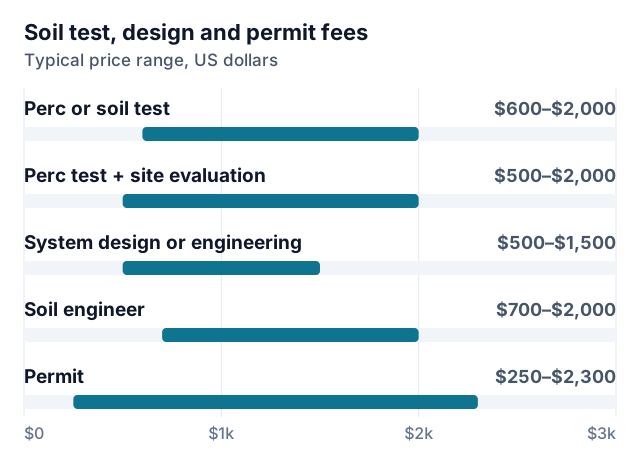
A perc or soil test typically costs $600 to $2,000 (HomeGuide), and Angi puts the average at about $1,300. System design or engineering adds $500 to $1,500 (theseptic.guide). The result decides which drain field your lot can have: a conventional trench on fast, deep soil, or a larger field or mound on slow clay, shallow rock or high groundwater.
A percolation (perc) or soil test typically costs $600 to $2,000 (HomeGuide), and Angi puts the average at about $1,300. System design or engineering adds $500 to $1,500 (theseptic.guide), with soil engineers at $700 to $2,000 (HomeAdvisor). The test comes before the permit and the design, because its result decides what kind of drain field your lot can have.
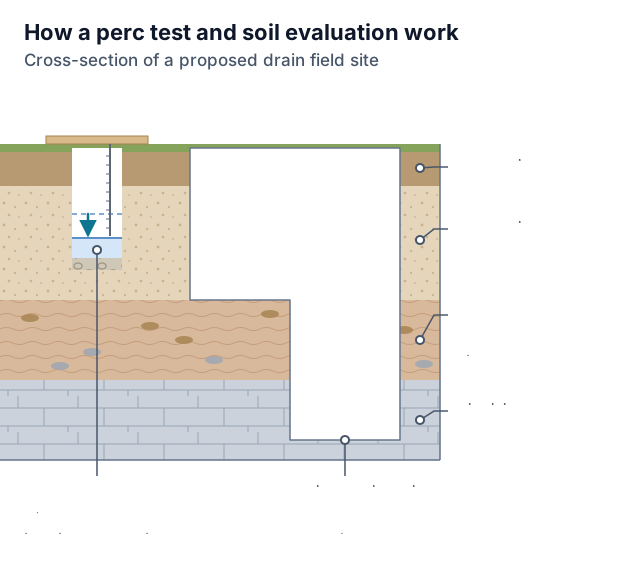
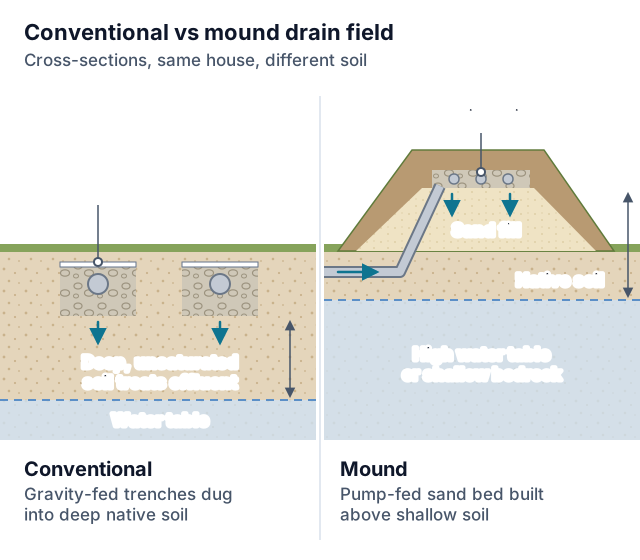
A perc test measures how fast water soaks into your soil, usually with test holes dug where the field will go. Many counties also require a deep soil profile to find the seasonal high water table. Fast, deep soils allow a compact conventional trench ($2,000 to $6,000 for the field, HomeGuide). Slow clay, shallow bedrock or high groundwater push you toward a larger field or a mound ($10,000 to $20,000, HomeGuide).
Typical national range
$600 – $2,000
Angi avg ~$1,300
Cost breakdown
| Item | Typical range | Notes |
|---|---|---|
| Perc / soil test | $600 – $2,000 | HomeGuide; Angi avg ~$1,300 |
| Perc test + site evaluation | $500 – $2,000 | theseptic.guide |
| System design / engineering | $500 – $1,500 | theseptic.guide |
| Soil engineer | $700 – $2,000 | HomeAdvisor |
| Permit | $250 – $2,300 | envelope: HomeGuide low, HomeAdvisor high |
| Conventional field (soil passes) | $2,000 – $6,000 | HomeGuide |
| Mound field (shallow soil or high water table) | $10,000 – $20,000 | HomeGuide |
What changes the price
Providers quote their own work — these are the factors that consistently move the number.
- Who may do the test. Texas requires a preconstruction site evaluation by a licensed site evaluator or professional engineer; Virginia requires a licensed Onsite Soil Evaluator or professional engineer; in Pennsylvania the local Sewage Enforcement Officer does the soil profiles and perc tests.
- Number of test holes. Pennsylvania's rule calls for six or more test holes in the proposed absorption area (25 Pa. Code § 73.15).
- Equipment and access. Union County, NC asks the owner to supply a backhoe with at least a 2-ft bucket and an operator for new-system evaluations, and in Washington the owner prepares the soil log pits.
- Engineered design. Slow, shallow or wet soil means a designed system: $500–$1,500 for design (theseptic.guide) or $700–$2,000 for a soil engineer (HomeAdvisor).
- Health-department fees. In some counties the health department does the evaluation for a permit fee. Union County, NC charges a $400 improvement-permit application.
How perc test results change your drain field price
Fast, deep soils allow a compact conventional trench, $2,000 to $6,000 for the field (HomeGuide). Slow clay, shallow bedrock or high groundwater push you toward a larger field or a mound, $10,000 to $20,000 (HomeGuide). That is why the soil test is the first line of any drain field budget: it sets the size and the type, and the type is usually the biggest swing in price.
Septic and drain field permits by state
Who issues the permit to install or replace a septic system or drain field, and what soil or perc testing each state requires. We list only states where we could confirm the rule on an official state page (checked 2026-10-13); each source is listed below. Counties and local health departments often add their own rules, so call your local office before you hire a designer.
Texas: TCEQ, or the local authorized agent, issues the permit. A permit and approved plan are required to construct, alter, repair, extend and operate an on-site sewage facility; some 10-acre single-family sites can be exempt. Testing: a preconstruction site evaluation by a licensed site evaluator or professional engineer, including a soil analysis in the proposed disposal area.
Florida: the county health department issues the permit (DEP in some Panhandle counties and Marion County), on a construction permit application (DEP 4015) with a site plan and the building floor plan. Testing: a site evaluation of soil, topography and other conditions, done by the agency or a qualified private evaluator.
Georgia: the county board of health issues permits on sites found suitable by a soil evaluation, and a construction permit is valid for up to 12 months. Testing: a soil evaluation report that meets the DPH manual's Section C checklist; DPH lists certified soil classifiers for Level III soil reports.
Pennsylvania: the lot owner applies through the local agency's Sewage Enforcement Officer (SEO), who must inspect the finished system before it is covered. Testing: the SEO does soil profile examinations and percolation tests, with six or more test holes in the proposed absorption area (25 Pa. Code § 73.15).
Virginia: the Virginia Department of Health (local health district) issues a permit to construct a sewage system, which is needed before the county issues a building permit on property without public sewer. Testing: a site and soil evaluation report from a licensed Onsite Soil Evaluator or professional engineer. VDH provides evaluation services only to owners who qualify through a petition.
Washington: the local health officer reviews applications under the state on-site sewage rules (WAC 246-272A). Testing: soil and site evaluation by a professional engineer, licensed designer or the local health officer; the owner prepares the soil log pits.
This is a summary, not legal advice. The state source and your local permitting office have the final word. Our county pages list local fees and offices for the six counties we cover.
Frequently Asked Questions
How much does a perc test cost?
$600–$2,000 (HomeGuide); Angi says about $1,300 on average. Design or engineering adds $500–$1,500 (theseptic.guide).
Do I need a perc test to replace a drain field?
Usually some soil evaluation is needed, because the new field is sized to the soil. Ask your county whether a soil evaluation or perc test is required and who may perform it.
What if my lot fails the perc test?
Designed systems (mound, drip or an aerobic unit) are the usual fallback. A mound field runs $10,000–$20,000 (HomeGuide); see the cost-by-type table in our drain field replacement cost guide.
Who issues septic permits?
It depends on the state: TCEQ or a local authorized agent in Texas, the county health department in Florida and the county board of health in Georgia, the local Sewage Enforcement Officer in Pennsylvania, the Virginia Department of Health, and the local health officer in Washington.
Estimates only — independent local providers quote their own pricing. Data last reviewed 2026-10.
Sources
- HomeGuide — Drain/Leach Field Replacement Cost (Dec 2025) (third-party estimate)
- Angi — How Much Do New Drain Fields Cost? (Jul 8, 2026) (third-party estimate)
- HomeAdvisor — Septic System Installation Cost (Jun 20, 2026) (third-party estimate)
- theseptic.guide — Drainfield Replacement Cost (Mar 2026) (third-party estimate)
- TCEQ — OSSF permits (Texas)
- Florida DEP — Onsite sewage permitting FAQ
- Georgia Rules 511-3-1 (onsite sewage)
- Georgia DPH — Onsite Sewage
- 25 Pa. Code § 73.15 (percolation tests)
- PA DEP — Onlot Sewage Program guide
- Virginia Department of Health — Onsite program (well and septic)
- VDH — Onsite Sewage Forms
- WAC 246-272A-0220 (soil and site evaluation)
- Union County (NC) Environmental Health Fees
Prefer to just talk to someone?
Send the short form — we'll route you to an independent local pro.