Drain Field Repair in North Carolina, NC
Drain field replacement typically runs $3,000–$15,000 nationally, per our cost guide. Independent local pros serving Union County, Johnston County, Monroe and nearby areas. Describe the problem and we'll route your request — free, no obligation.
- Replacement typically $3,000–$15,000 (avg $7,900, HomeGuide)
- Mound, drip and aerobic systems $10,000–$20,000+
- Free quotes from licensed local installers
Fast response from independent local providers. No obligation.
Typical national cost$3,000 – $15,000Cost guide →Local Help in North Carolina, NC
North Carolina regulates septic systems and their dispersal fields as wastewater systems under Article 11 of Chapter 130A of the General Statutes, with siting, design, operation and repair rules in 15A NCAC 18E. At the state level the program sits in the On-Site Water Protection Branch, part of the Environmental Health Section in the Division of Public Health at the Department of Health and Human Services (DHHS). Improvement Permits and Construction Authorizations are issued by the local health department (G.S. 130A-336 also names the Department). Under G.S. 130A-335(c), a system is reviewed and approved under a local board of health's own rules only when that board has asked the Department to review them, has adopted the state rules by reference with any more stringent changes it deems necessary, and the Department has found them at least as stringent and sufficient and necessary to safeguard public health.
What counts as a repair is set by statute. G.S. 130A-334(9a) defines repair as "the extension, alteration, replacement, or relocation of existing components of a wastewater system," and says replacing a damaged gravity distribution box is not a repair when a contractor certified under Article 5 of Chapter 90A does it. Maintenance, under (3a), is normal or routine work such as replacing broken pipes, cleaning or adjusting an existing system.
G.S. 130A-336(b) makes two documents, an Improvement Permit and a Construction Authorization issued by the Department or the local health department, a condition for starting or assisting with any installation, construction or repair. The exceptions are work under the engineered option permit (G.S. 130A-336.1) or the Authorized On-Site Wastewater Evaluator (AOWE) option (G.S. 130A-336.2), and maintenance requires neither document.
North Carolina Service Details
What providers in this area actually see: coverage, common jobs, local pricing factors, and rules worth knowing.
Service Area Notes
- Union County page: how the county's Environmental Health division handles repair requests, its records and its fee page, and soils such as Badin and Cid.
- Johnston County page: the county's repair permit and dated fee schedule, its pump-system inspections, and wet Coastal Plain soils such as Rains.
- This guide links only the North Carolina counties with pages on this site. Elsewhere, the county's local health department is the place to start. Cornelia Cove LLC does not issue permits and does not speak for DHHS or any health department.
Common Jobs in North Carolina
- Repairing or replacing a dispersal field under an Improvement Permit and Construction Authorization, or under the engineered option or AOWE route
- Replacing a damaged gravity distribution box, which is not a repair under G.S. 130A-334(9a) when a certified on-site wastewater contractor does it
- Repair designs built on a licensed soil scientist's evaluation of soil conditions and site features, or a licensed geologist's evaluation of geologic and hydrogeologic conditions, under G.S. 130A-335(a1) and (a2), which the permitting authorities approve if the work is inside the evaluator's licensed scope and the evaluator holds errors and omissions coverage, sized to the risk, from a Chapter 58-licensed insurer
- Abandoning a field that cannot be repaired, which Rule 18E .1306(f) takes out of use and sends to the abandonment steps of Rule .1307
- Connecting a house to a city or county sewer line instead of repairing
What Drives Pricing Here
- Soil texture and field size: Rule 18E .0901(c) assigns a long-term acceptance rate (LTAR) from Table XVII for soil or Table XVIII for saprolite, based on textural class, structure, consistence, soil wetness, depth, coarse rock, landscape position, topography and system type, and the rule's sizing criteria are based on soil receiving domestic-strength effluent. Table XVII runs from 0.8 to 1.2 gallons per day per square foot for Group I sands down to 0.1 to 0.4 for Group IV clays, and a facility generating high-strength effluent or with a full kitchen may not exceed the mean rate for its Soil Group.
- Which permit route: the local health department route, the engineered option (designed by a licensed professional engineer with on-site wastewater expertise, per G.S. 130A-334(1h)) and the AOWE route each carry their own design, inspection and filing duties under G.S. 130A-336.1, 130A-336.2 and 130A-337.
- Contractor level: G.S. 90A-72(a) requires the installing contractor to be certified at the level required for the specified system.
- Fees are set locally; the county pages show what Union and Johnston publish.
Permits & Local Rules
- Before cover and use: a new or repaired system stays uncovered and out of service, under G.S. 130A-337(a), until the local health department has inspected it and found the installation or repair consistent with the Improvement Permit, the Construction Authorization, the rules and the statute. Subsections (a1) and (a2) allow verification by an AOWE, a licensed engineer or a certified Private Compliance Inspector instead, each with written-verification, insurance or filing conditions the statute lists; check those subsections before choosing one. Occupying the building, or putting the system into use or reuse, waits for an operation permit under subsection (d), or for the written authorization subsection (c) provides in a manufactured home park.
- Repair deadline: under Rule 18E .1306(a)-(c), when a system is malfunctioning or otherwise needs repair, the local health department or the Department issues a written notice of violation (NOV), and the repair is due 30 days from the date printed on it. The NOV may set another time frame based on site-specific factors; the rule's examples are how severe the repair is, wastewater backing up into a restaurant or discharging into SA waters, and bad weather that holds up construction. Unless maintenance alone restores compliance, the owner files a repair application under Section .0200, and the finished repair has to eliminate any public health hazard. Paragraph (c)(2) also offers a best professional judgement repair on a Department form, with limits and owner obligations stated in the rule; ask the health department about it.
- Which rules apply: under Rule 18E .0102(a), a system that already held an approval (an IP, CA, operation permit or equivalent) before January 1, 2024 stays outside 18E until its design daily flow or wastewater strength goes up, while systems malfunctioning under Rule .1303(a)(2) must follow 18E and Rule .0206 applies to systems with pre-2024 operation approvals. Under .0102(f), Section .1300 (operation and maintenance) applies to every system. The Johnston County page covers the component-reuse provisions of .0102(g) and (h).
- Certification: G.S. 90A-72(a) bars anyone from constructing, installing or repairing, or offering to, a permitted on-site wastewater system without certification as a contractor at the level required for that system, and also requires certification to conduct inspections, AOWE evaluations and private compliance inspections, as that subsection details. The certification board's page says that, effective 1/1/25, all applicants for certification must pass an exam, and that applying for Grade Level IV installer requires holding a satisfactory Grade Level II installer certification for at least two years and completing the Advance to GL IV class.
Local Conditions
- Soil groups: Table IV in Rule 18E .0503 sorts suitable textures into Group I sands (sand, loamy sand), Group II coarse loams (sandy loam, loam), Group III fine loams (sandy clay loam, silt loam, clay loam, silty clay loam, silt) and Group IV clays (sandy clay, silty clay, clay).
- Soil wetness: Rule .0504 reads soil wetness conditions, such as a seasonal high or perched water table, tidal water or lateral water movement, from field indicators. Under .0504(b), a site where that condition is less than 12 inches below the naturally occurring soil surface, or less than 18 inches if more than six inches of Group I soils are present, is unsuitable with respect to soil wetness, though paragraph (c) allows monitoring or modeling under the rule to reclassify the site as suitable.
- Piedmont rock: NRCS describes the Badin series (see the Union County page) as moderately deep, well drained soils on Piedmont uplands whose parent material is residuum weathered from the Carolina Slate Belt's fine-grained metasedimentary and metavolcanic rock; depth to weathered bedrock is 20 to 40 inches.
- Coastal Plain water: the Rains series (see the Johnston County page) is a poorly drained soil whose official description places it on flats, depressions and Carolina bays of the middle and upper coastal plain, and puts its seasonal high water table between the surface and 12 inches down, December through April.
Neighborhoods & Suburbs Served
Union County · Johnston County · Monroe · Indian Trail · Smithfield
Emergency Response Expectations
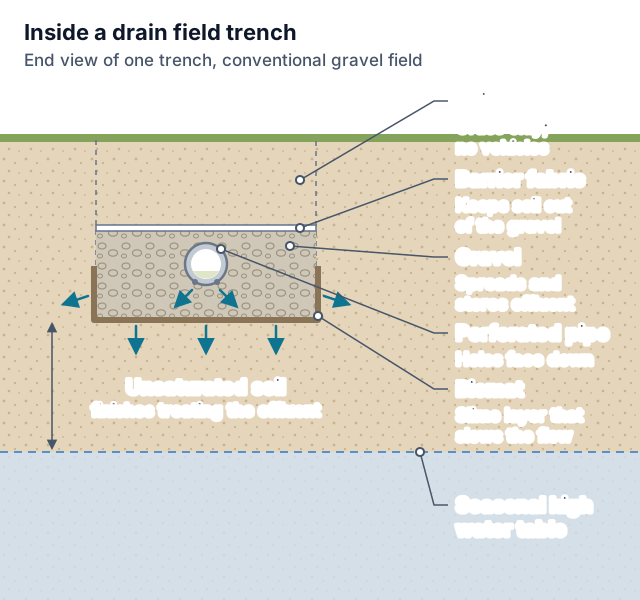
Effluent on the ground or sewage coming back up the drains are among the conditions Rule 18E .1303(a)(2) treats as a malfunction, and the rule directs the owner to contact the local health department, plus the professional engineer or AOWE for a system permitted through one of them. Replacing components after that is a repair needing permits under G.S. 130A-336 unless maintenance alone will bring the system back into compliance, and under Rule .1306(c) the repair is due within 30 days of the date on the notice of violation unless that notice sets a different time frame.
North Carolina FAQs
Do I need a permit to replace a drain field in North Carolina?
Yes when the work is a repair: replacing or relocating existing components needs an Improvement Permit and a Construction Authorization from the Department or the local health department, unless the work follows the engineered option or AOWE route. Maintenance, such as replacing broken pipes or cleaning, needs neither permit.
Can I repair the system on my own land myself?
G.S. 90A-72(b)(2) takes contractor certification off a person who constructs, installs or repairs a system described as a single septic tank with gravity-fed gravel trench dispersal media, if the land is that person's own and the system is intended solely for that person and immediate family members who reside in the same dwelling. The exemption covers certification only; the permits in G.S. 130A-336 and the inspection in G.S. 130A-337 still apply. Subsection (b) also exempts certain supervised employees, licensed general contractors, plumbing contractors, certified operators, NPDES permittees and health department staff doing regulatory inspections, each within limits it sets; read it before relying on one.
What makes a system malfunctioning, and who must I tell?
Under Rule 18E .1303(a)(2), the three conditions the rule names are sewage or effluent reaching the ground surface, surface waters or groundwater; a backup into the facility, building drains, collection system, tank freeboard volume or distribution system; and effluent within three inches of finished grade over one or more trenches, seen in two or more observations made at least 24 hours apart and more than 24 hours after a rainfall. A system showing any of them, or one whose tanks must be pumped more often than once a month to keep them from happening, is malfunctioning. The owner's duty then is to contact the local health department; if an engineered option or AOWE permit covers the system, the owner contacts that engineer or AOWE as well.
Can a city or county make me hook up to sewer instead of repairing?
A city may, under G.S. 160A-317(a), require the owner of developed property with dwelling units or commercial establishments, inside city limits and within a reasonable distance of a city water or sewer line, to connect, or, instead of requiring connection and to avoid hardship, may charge a periodic availability charge no higher than the minimum periodic service charge for connected properties. The owner is exempt from a mandatory sewer connection if the city lacks capacity to transport and treat the new wastewater at the time of connection, or if connection costs exceed the cost of an on-site system authorized under Article 11, as assessed by a licensed soil scientist, a certified on-site wastewater contractor or a licensed plumbing contractor; an owner who takes that route must meet Article 11 and its rules and has sole responsibility for the system. A county, under G.S. 153A-284(a), may require connection of developed property located so as to be served by a county line, but for sewer only if it has adequate capacity at the time of connection.
Sources
- G.S. 130A-334: Definitions
- G.S. 130A-335: Wastewater collection, treatment and disposal; rules
- G.S. 130A-336: Improvement permit and construction authorization
- G.S. 130A-336.1: Engineered option permit
- G.S. 130A-336.2: Authorized On-Site Wastewater Evaluator option
- G.S. 130A-337: Inspection; operation permit
- G.S. 90A-72: Certification required; applicability
- G.S. 160A-317: City power to require connections
- G.S. 153A-284: County power to require connections
- 15A NCAC 18E (OAH): Rules .0102, .0503, .0504, .0901, .1303, .1306 and .1307
- NC DHHS: On-Site Water Protection Branch
- NC On-Site Wastewater Contractors and Inspectors Certification Board: how to receive certification
- USDA NRCS: Badin soil series
- USDA NRCS: Rains soil series
- U.S. Census Bureau: 2020 North Carolina places by county
Last reviewed 2026-11-11
Counties in North Carolina
Services Available in North Carolina
Drain Field Replacement
A failed drain field usually requires a new field on fresh soil, sized to current code. Connect with local licensed installers for site evaluation and quotes.
Learn more →Drain Field Repair & Rejuvenation
Many slow or soggy drain fields can be repaired for $1,000–$5,000 when the problem is a broken pipe, a failed D-box, or clogged laterals rather than worn-out soil.
Learn more →Perc Test & Site Evaluation
A perc or soil test tells the designer how fast your soil accepts effluent, which sets field size and type. Expect $600–$2,000.
Learn more →Aerobic (ATU) Spray & Drip Field Installation
Where soil is too tight, shallow or wet for a conventional field, the answer is usually an ATU that discharges to a spray field or drip lines. $10,000–$20,000+.
Learn more →Free Tools Before You Call
Ballpark the cost or narrow down the problem before talking to a North Carolina provider.
Need help in North Carolina, NC?
Send the short form — urgent requests get priority routing.