Drain Field Repair in McLennan County, TX
Drain field replacement typically runs $3,000–$15,000 nationally, per our cost guide. Independent local pros serving Waco, Hewitt, Woodway and nearby communities. Describe the problem and we'll route your request — free, no obligation.
- Replacement typically $3,000–$15,000 (avg $7,900, HomeGuide)
- Mound, drip and aerobic systems $10,000–$20,000+
- Free quotes from licensed local installers
Fast response from independent local providers. No obligation.
Typical national cost$3,000 – $15,000Cost guide →Local Help in McLennan County, TX
TCEQ's OARS directory of on-site sewage facility (OSSF) regulators has one McLennan County listing: the county itself, as authorized agent for the "entire County." The Waco-McLennan County Public Health District runs that program: its OSSF page says an agreement between the City of Waco and McLennan County has the district administer it for the county, its cities and the City of Waco.
A new field is a repair in the state rule. Definition (61) of 30 TAC 285.2, which excludes maintenance and emergency repairs, says the replacement of tanks or drainfields "is considered a repair and requires a permit for the entire OSSF system."
TCEQ's "Types of Systems Installed by Time Period" report for 1/1/2025 to 12/31/2025 (dated 4/27/2026) shows McLennan County with 462 under the ATC (authorization to construct) heading. The same row prints 393 surface irrigation, 17 drip irrigation, 16 low pressure dosing, 12 standard trench/bed, 3 evap beds, 1 leaching chamber and 20 other; its remaining type columns show 0.
McLennan County Service Details
What providers in this area actually see: coverage, common jobs, local pricing factors, and rules worth knowing.
Service Area Notes
- The footer of the district's application packet reads "Serving the cities of Bellmead, Beverly Hills, Bruceville-Eddy, Crawford, Gholson, Golinda, Hallsburg, Hewitt, Lacy Lakeview, Leroy, Lorena, Mart, McGregor, Moody, Riesel, Robinson, Ross, Waco, West, Woodway, and all areas of McLennan County."
- Three of those cities cross county lines in the 2020 Census place-by-county listing for Texas: McGregor extends into Coryell County, Mart into Limestone County and Bruceville-Eddy into Falls County. For a lot on the far side of the line, search OARS under that county.
Common Jobs in McLennan County
- Replacing a failed drainfield under a repair permit
- Lengthening or expanding a disposal area, or moving a spray area, both named on the district's minor-repair fee line
- Replacing one tank, such as a collapsed pump tank, a job the fee schedule groups with minor repairs
- Replacing tank lids or inlet and outlet devices, repairing risers and riser caps, repairing or replacing disinfection devices, or fixing damaged drip tubing or solid lines, the example tasks in 285.35(b) (limits in the emergency note)
What Drives Pricing Here
- Fees: the district's OSSF page carries a schedule headed "Fee Schedule Effective October 1, 2026," that charges $510 for a conventional system and $710 for an aerobic system at a single-family residence ($610 and $810 for commercial or non-single-family). Each covers application, permit, inspections and notice of approval.
- Minor repair or not: the same schedule charges $285 for a single-family residence ($310 for commercial or non-single-family) for minor repairs, defined there as increasing, lengthening or expanding the treatment (tanks) or disposal system (drain field/disposal area), relocating a spray area, or replacing a single tank such as a collapsed pump tank.
- A state add-on: the schedule adds a $10 mandatory fee on all permits, new or repairs, and says the money goes to the TCEQ Research Council with no portion retained. Health and Safety Code §367.010 has each county, municipality, public health department and river authority collect $10 per on-site wastewater treatment permit application processed and forward it to the commission.
- Failed work: the schedule's Failed/Reinspection Fees are $200 for a single-family residence and $300 for commercial or non-single-family, with $100 for a design resubmittal; under 30 TAC 285.3(d)(6) a reinspection fee must be paid before the reinspection is conducted.
- Who must draw the plans: spray, low-pressure dosed and other systems not defined in 285.33(b) or (c) are nonstandard, and 285.33(d) requires a professional engineer or professional sanitarian to develop their planning materials.
- How much ground the system needs: for spray, 285.33(d)(2)(E) sets the minimum application area by dividing the daily usage rate (Q) from 285.91(3) by the allowable surface application rate (Ri, in gallons per square foot per day) found in 285.90(1) or as approved by the permitting authority.
Permits & Local Rules
- Permit first: under 30 TAC 285.3(a), a person needs a permit and an approved plan for any OSSF construction, alteration, repair, extension or operation, except where a subsection (f) exception fits (see the FAQ on large tracts). Section 285.3(b)(1) bars starting construction until the owner or the owner's agent holds an authorization to construct; to issue one, the permitting authority requires an application on its form, all 285.5 planning materials, the results of a 285.30 site evaluation and the appropriate fee.
- Locally, the packet's list of required documents for systems other than aerobic is the permit application and checklist, the design/site and soil evaluation, recorded proof of ownership with legal description, a recorded plat or surveyor's drawing with stamp and field notes, a floodplain certificate and the homeowner information sheet. An aerobic system adds the Affidavit to the Public and the initial two-year service agreement; the packet's instructions say the affidavit must be completed, notarized and filed in the county's records for an aerobic system or any other system that requires secondary treatment, and 30 TAC 285.3(b)(3) sets the state's affidavit rule for the systems listed in 285.91(12). The packet asks for the site and soil analysis from a Registered Site Evaluator or Professional Engineer and the design from a Registered Sanitarian or Professional Engineer.
- Clock: under 285.3(c) the permitting authority approves or denies an application within 30 days of receiving it. An authorization to construct lapses if the installer requests no construction inspection within one calendar year of issuance, and the owner must then reapply and pay again, unless the owner decides not to install an OSSF (285.3(d)(1)).
- Inspections: 285.3(d)(2) says the installer "shall notify the permitting authority at least five working days (Monday through Friday, excluding holidays) before the date the OSSF will be ready for inspection"; the district's instructions instead describe calling its inspection line by 8:00 a.m. for a same-day inspection, or emailing a request. Ask the district which lead time applies. The packet adds that a system cannot be placed into service until it passes a final inspection and a Notice of Approval is issued.
Local Conditions
- Clays rated for slow water movement: NRCS's McLennan County soil survey (TX309) rates "Houston Black clay, 1 to 3 percent slopes" (41,197 acres), "Heiden clay, 1 to 3 percent slopes" (38,269 acres) and "Wilson clay loam, 0 to 2 percent slopes" (42,381 acres) as Very limited for septic tank absorption fields, each for slow water movement. The Houston Black series description adds: "Water enters the soil rapidly when it is dry and cracked, and very slowly when it is moist."
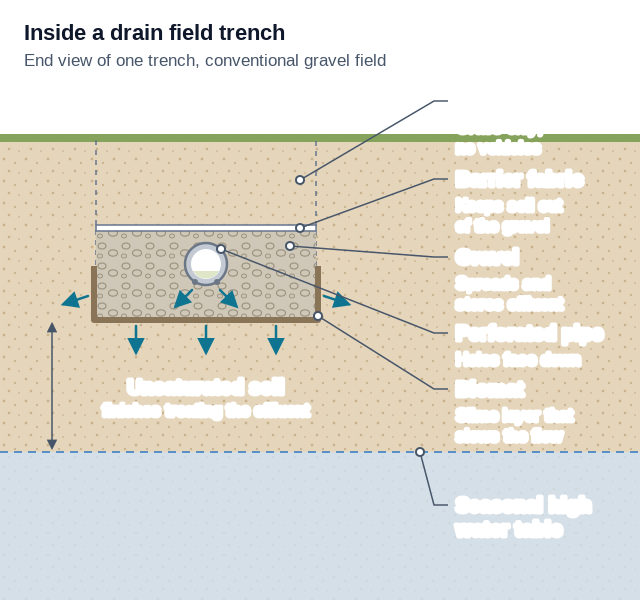
- Seasonal wetness on stream-terrace soils: the Wilson series description calls the soil seasonally wet, saturated in the surface layer and upper part of the Bt horizon during winter and spring for periods of 10 to 30 days. That is one series, not the county. At the site, 285.30(b)(2) calls for checking the soil profile for indications of groundwater within 24 inches of the bottom of the excavation, and 285.30(b)(1)(C) states: "Clay subsoils, rock, and plugged laminar soils are considered restrictive horizons." For an absorptive drainfield, 285.33(b)(1) adds: "There shall be two feet of suitable soil from the bottom of the excavation to either a restrictive horizon or to groundwater."
- Chalk close to the surface: the Austin and Stephen series, both with type locations near Lorena, formed in residuum weathered from chalk. NRCS calls Austin soils moderately deep and Stephen soils shallow, with a paralithic contact 18 to 51 cm (7 to 20 in) down. The survey rates "Stephen-Eddy complex, 2 to 5 percent slopes" (21,754 acres) Very limited for depth to bedrock in both components.
- Groundwater by the river: the Southern Trinity Groundwater Conservation District's management plan (July 15, 2021, still the posted plan; TWDB shows the next one due 09/09/2026) places the Brazos River Alluvium Aquifer in floodplain and terrace deposits near the Brazos and calls it unconfined, recharged mainly by precipitation on the floodplain. TWDB's aquifer page says the aquifer is under water table conditions in most places.
- Flood plains: the survey rates "Tinn clay, 0 to 1 percent slopes, frequently flooded" (26,209 acres) Very limited for flooding and slow water movement. Section 285.31(c)(2) subjects any site within a 100-year floodplain to special planning requirements: "The OSSF shall be located so that a flood will not damage the OSSF during a flood event, resulting in contamination of the environment. Planning materials shall indicate how tank flotation is eliminated." Sites within the regulated floodway need further showings by a professional engineer. The packet includes the county's Floodplain Development Permit form, tied to its "Flood Damage Prevention Order."
- Rain: for Waco Regional Airport (station USW00013959), NOAA's 1991-2020 normals give annual precipitation of 36.40 inches.
Communities Served
Waco · Hewitt · Woodway · Robinson · Lorena · McGregor · China Spring · Mart · Moody · West · Bellmead · Lacy-Lakeview · Crawford · Riesel
Emergency Response Expectations
Sewage on the ground is a nuisance in the state rule's terms: 30 TAC 285.2(43)(B) covers "an overflow from a septic tank or similar device, including surface discharge from or groundwater contamination by a component of an on-site sewage facility." Section 285.35(a) permits an emergency repair only if it "is made for the abatement of an immediate, serious and dangerous health hazard" and "does not constitute an alteration of that OSSF system's planning materials and function." Subsection (b) lists example tasks, and such repairs must still meet the chapter's criteria. Under 285.35(c), the person authorized to make the repair must send the permitting authority (for this county, the health district) written notice within 72 hours after starting, describing in detail the methods and materials used; 285.35(d) lets the permitting authority require an inspection. Because a new field is a repair needing a permit, start with the district's OSSF program page.
McLennan County FAQs
Does the $285 minor-repair permit cover my field work?
Only if the job fits the schedule's minor-repair definition (see the cost notes above). The application form offers three boxes, New, Minor Repair and Tank Replacement, and because 30 TAC 285.2 says replacing a drainfield requires a permit for the entire OSSF, confirm with the district which box and fee a full replacement takes.
Where may a spray area go, and when may it run?
Under 30 TAC 285.33(d)(2)(A)-(B), the area must be flat (15% slope or less) and covered with grasses, evergreen shrubs, bushes, trees or landscaped beds, with nothing within ten feet of a sprinkler that would interfere with uniform application; steeper land may be acceptable if properly landscaped and terraced to minimize runoff. Land used for growing food, gardens, orchards or crops that may be used for human consumption, and unseeded bare ground, may not be used. Where the separation between the property line and the edge of the spray area is under 20 feet, (G)(i) states that "sprinkler operation shall be controlled by timers set to spray between midnight and 5:00 a.m."
Once the district finds my system malfunctioning, when must repairs start?
The clock in 30 TAC 285.70(a) starts on the date the executive director or the authorized agent notifies the owner, and the owner must initiate repair no later than the 30th day after it when there was no earlier notice of the malfunction in the previous 12 months, the 20th day after one or more such notices in that span, or the 10th day after two or more. These are start dates; the rule does not set a completion date there.
I own more than ten acres. Do I still need a permit to replace the field?
Under 30 TAC 285.3(f)(2), an OSSF serving a single-family dwelling located on a tract of land of ten acres or larger needs no planning materials, permit or inspections, provided it complies with all other Subchapter D requirements and meets four conditions: it causes no nuisance and does not pollute groundwater; every part of it is 100 feet or more from the property line; its effluent stays on the property; and that dwelling is the only one on the tract. Subsection (f) lists other exceptions, each with its own conditions. The district's homeowner sheet cites an On-Site Sewage Facilities Order for McLennan County, which its OSSF page does not post, so ask the district whether that order adds requirements before relying on any exception.
Sources
- Waco-McLennan County Public Health District: OSSF Program and fee schedule
- Health district: OSSF permit application packet
- TCEQ OARS: OSSF authorized agents by county (choose McLennan)
- TCEQ: Types of Systems Installed by Time Period, 2025
- Texas SOS: 30 TAC 285.2, Definitions
- Texas SOS: 30 TAC 285.3, General Requirements
- Texas SOS: 30 TAC 285.30, Site Evaluation
- Texas SOS: 30 TAC 285.31, Selection Criteria
- Texas SOS: 30 TAC 285.33, Criteria for Effluent Disposal Systems
- Texas SOS: 30 TAC 285.35, Emergency Repairs
- Texas SOS: 30 TAC 285.70, Duties of Owners With Malfunctioning OSSFs
- Texas Health and Safety Code Chapter 367 (§367.010, fees)
- USDA NRCS Web Soil Survey (survey area TX309, McLennan County)
- NRCS official series description: Houston Black
- NRCS official series description: Wilson
- NRCS official series description: Austin
- NRCS official series description: Stephen
- Southern Trinity GCD Management Plan (July 15, 2021)
- TWDB: Groundwater conservation district management plans (Southern Trinity GCD)
- TWDB: Brazos River Alluvium Aquifer
- NOAA NCEI 1991-2020 normals, Waco Regional Airport (USW00013959)
- Census Bureau: 2020 place-by-county relationship file, Texas
Last reviewed 2026-11-11
Nearby Counties
Services Available in McLennan County
Drain Field Replacement
A failed drain field usually requires a new field on fresh soil, sized to current code. Connect with local licensed installers for site evaluation and quotes.
Learn more →Drain Field Repair & Rejuvenation
Many slow or soggy drain fields can be repaired for $1,000–$5,000 when the problem is a broken pipe, a failed D-box, or clogged laterals rather than worn-out soil.
Learn more →Perc Test & Site Evaluation
A perc or soil test tells the designer how fast your soil accepts effluent, which sets field size and type. Expect $600–$2,000.
Learn more →Aerobic (ATU) Spray & Drip Field Installation
Where soil is too tight, shallow or wet for a conventional field, the answer is usually an ATU that discharges to a spray field or drip lines. $10,000–$20,000+.
Learn more →Free Tools Before You Call
Ballpark the cost or narrow down the problem before talking to a McLennan County provider.
Need help in McLennan County, TX?
Send the short form — urgent requests get priority routing.