Signs Your Drain Field Is Failing (and What to Check First)
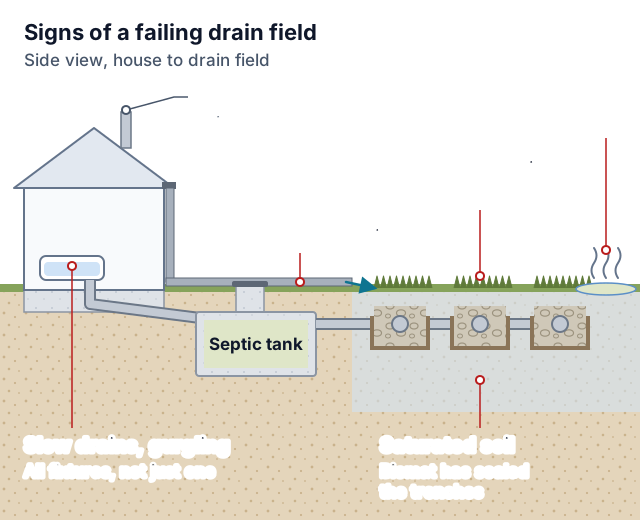
A failing drain field usually shows up as slow drains and gurgling throughout the house, sewage odor in the yard, or soggy ground over the field when it has not rained. The same signs can come from problems that cost far less to fix: a full tank, a blocked baffle or filter, or a crushed pipe.
Rule those out before anyone quotes you a new field. The steps below cover what to do now, what to stay away from, and the causes to check, cheapest first.
If this is unsafe or getting worse right now, don't wait — send an emergency request and it's flagged for priority routing to an independent local pro.
What to do in the first 5 minutes
- Cut water use. Spread out laundry, skip long showers and fix running toilets. Overloading the system with water shortens field life, and a struggling field can't take more.
- Keep people and pets away from any spot where sewage is surfacing or the ground is soggy.
- Note what you see and where: slow drains in one fixture or the whole house, odor, wet spots, or unusually green stripes of grass over the trenches. It helps the contractor diagnose the problem.
- Have the tank pumped (typically $292 to $565, Angi) and inspected ($150 to $450, HomeGuide) before anything else. It is the cheapest diagnostic step and rules out a full tank or a blocked outlet.
- If sewage is surfacing or backing up, call your county health department or permitting office before any repair. Most counties require a repair permit, and Texas requires emergency repairs to be reported within 72 hours.
Do not do this
- Surfacing effluent is a health hazard. Don't let children, pets or anyone else walk or play on a wet drain field.
- Don't park or drive on the drain field. Vehicles compact the soil and crush the pipes (EPA).
- Never open the septic tank lid to look inside. The gases are toxic and the opening is a fall hazard.
- Don't send roof drains, sump pumps or other rainwater toward the field while it is struggling (EPA).
What's likely going on
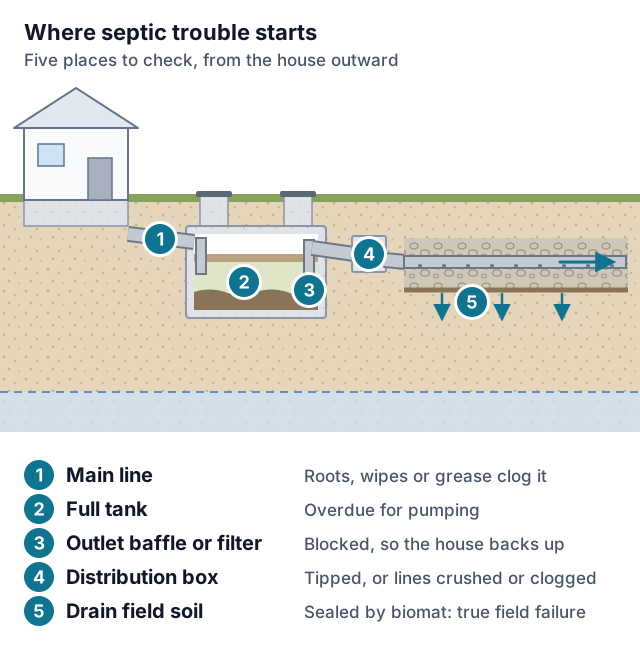
Full tank overdue for pumping
Solids that reach the outlet can mimic field failure. Pumping typically costs $292 to $565 (Angi), and EPA says household tanks are usually pumped every three to five years.
Blocked outlet baffle or clogged effluent filter
A blocked baffle or filter at the tank outlet stops effluent from reaching the field, so the house backs up even though the field is fine. An inspection ($150 to $450, HomeGuide) finds it.
Crushed or broken line between the tank and field
A crushed pipe, often from vehicles or construction over the line, dams the flow. Broken laterals are replaced by the foot.
Failed distribution box or clogged laterals
A new distribution box costs $500 to $1,500 (HomeAdvisor), and jetting the lines $200 to $1,400 (HomeGuide). Either can buy years if the soil still drains.
Biomat-sealed soil (true field failure)
When the soil under the trenches seals with biomat it stops accepting water. Fields that have biomatted solid usually need replacement: typically $3,000 to $15,000, about $7,900 on average (HomeGuide).
What it typically costs
Start with the cheap checks: pumping $292 to $565 (Angi) and an inspection $150 to $450 (HomeGuide). If the field itself is the problem, jetting runs $200 to $1,400 (HomeGuide) and a new distribution box $500 to $1,500 (HomeAdvisor). HomeGuide puts repair or rejuvenation at $1,000 to $5,000 and full replacement at $3,000 to $15,000.
Frequently Asked Questions
What are the signs of a failing drain field?
Slow drains and gurgling throughout the house, not just one fixture; sewage odor in the yard, especially after heavy use; soggy ground or standing water over the field when it has not rained; unusually green, lush grass in stripes over the trenches; sewage backing up into the lowest drains; and high nitrate or bacteria results in a nearby well test.
Is it the drain field or just a full tank?
Check the cheaper causes first. A full tank, a blocked outlet baffle, a clogged effluent filter or a crushed line between the tank and field can all mimic field failure. Have the tank pumped (typically $292 to $565, Angi) and inspected ($150 to $450, HomeGuide) before paying for a field diagnosis.
Can a drain field be repaired?
Sometimes. Jetting the lines ($200 to $1,400, HomeGuide), replacing a distribution box ($500 to $1,500, HomeAdvisor) or resting the field while a new section is added can buy years. HomeGuide puts repair or rejuvenation at $1,000 to $5,000. Fields that have biomatted solid usually need replacement.
Can I drive or build on a drain field?
No. Vehicles compact soil and crush pipes. Keep structures, pools and trees with aggressive roots away from the field.
The service that handles this
Guidance only — independent local providers assess and price their own work. Last reviewed: October 16, 2026.
Sources for the cost figures
- HomeGuide — Drain/Leach Field Replacement Cost (Dec 22, 2025) (third-party estimate)
- Angi — Septic Tank Pumping Cost (Oct 14, 2026) (third-party estimate)
- Angi — How Much Do New Drain Fields Cost? (Jul 8, 2026) (third-party estimate)
- HomeAdvisor — Septic System Installation Cost (Jun 20, 2026) (third-party estimate)
- theseptic.guide — Drainfield Replacement Cost (Mar 2026) (third-party estimate)
- EPA — How to Care for Your Septic System
Related Resources
Prefer to just talk to someone?
Send the short form — we'll route you to an independent local pro.