Drain Field Repair in Florida, FL
Drain field replacement typically runs $3,000–$15,000 nationally, per our cost guide. Independent local pros serving Lake County, Hernando County, Clermont and nearby areas. Describe the problem and we'll route your request — free, no obligation.
- Replacement typically $3,000–$15,000 (avg $7,900, HomeGuide)
- Mound, drip and aerobic systems $10,000–$20,000+
- Free quotes from licensed local installers
Fast response from independent local providers. No obligation.
Typical national cost$3,000 – $15,000Cost guide →Local Help in Florida, FL
Florida's septic statute is section 381.0065 of the Florida Statutes, and the Department of Environmental Protection (DEP) writes the standards in Chapter 62-6 of the Florida Administrative Code. Who takes the application depends on the county. DEP's permitting FAQ says DEP itself permits in Northwest Florida and Marion County, while in the counties it lists separately, Lake and Hernando among them, permits are issued by the Environmental Public Health Program of the Department of Health's local county health department. The FAQ adds that "the transition of the remaining 50 counties will occur depending on legislative approval" and that many counties have local ordinances that may exceed state requirements.
Section 381.0065(4) makes a department-approved permit the precondition for building, repairing, modifying, abandoning or operating a septic system, and gives a repair permit 90 days of life from its issue date. Rule 62-6.003(1) puts every repair under a system construction permit and relies on Rule 62-6.002 to draw the line between repairs and other work; the Lake County page quotes that definition and its exclusions.
The opening of Rule 62-6.015 requires that the Department with jurisdiction know about, and approve in writing, any repair to a failing system before it is made. The owner or lessee (or an agent) asks for the repair permit before work begins by filing application Form DEP 4015 with its exhibits and fees; the permit itself comes on Form DEP 4016.
Florida Service Details
What providers in this area actually see: coverage, common jobs, local pricing factors, and rules worth knowing.
Service Area Notes
- Lake County page: the county health department permits there, and the page covers springs-plan rules for parts of the county and the Green Swamp inspection rule.
- Hernando County page: the county health department permits there, and the page covers two springs restoration plans whose areas take in Hernando land.
- This guide links only the Florida counties with pages on this site; DEP's permitting FAQ shows which office handles every other county. Cornelia Cove LLC does not issue permits and does not speak for DEP or any county health department.
Common Jobs in Florida
- Drainfield replacement under a repair permit after a site evaluation; in the counties where the county health department permits, DEP's FAQ says a qualified professional must perform it and the county health department can do it for a fee
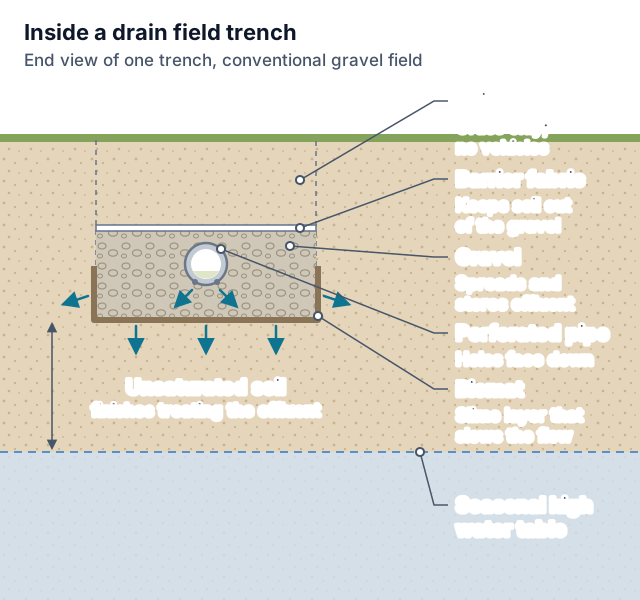
- Repairs by any method other than adding or replacing drainfield, such as high-pressure water jetting, air injection alongside the drainfield or a chemical compound, for which Rule 62-6.015(3) requires added application details. If the drainfield's absorption surface lies within 6 inches of the wet season high water table, subsection (4) rules those methods out and calls for removing the drainfield and installing a replacement
- Nitrogen-reducing systems where a springs basin management action plan (BMAP) or state law requires one
- Connecting a house to a central sewer when the law requires it instead of a repair
What Drives Pricing Here
- State fees: the fee rule, 62-6.030 (effective June 8, 2026), prices the pieces of a repair separately: application with existing system and system repair evaluation, $50; permit or permit application amendment for a new system, modification or repair, $55; research/training surcharge on new and repair permits, $5; site evaluation, $115; initial system inspection, $75; each system reinspection, $50. Per DEP's FAQ, the county health department adds up the total, including any county fees, according to the system type and the services the applicant asks for. Under Rule 62-6.003(1)(d), a repair system construction permit issued within 12 months from the date of final installation approval carries no fee.
- Water table: Table V in Rule 62-6.015 sets the separation between the bottom of the drainfield and the wet season water table that a repair must meet, with minimums keyed to when the system was first permitted (the county pages give the figures); under subsection (7), no part of the rule can be read to let a drainfield stay in the wet season water table.
- Size: Rule 62-6.015(10) sets the old drainfield area as the floor for the repair, with the only exception being subsection (7), which applies where the standards of subsection (6) cannot be met.
- Who does the work: under s. 381.0065(4), a person who contracts to construct, modify, alter, repair, service, abandon or maintain any portion of a septic system must be registered under part III of chapter 489, and s. 489.551(1) makes DEP the "department" for that part. Section 489.552 adds that nothing in part III prohibits a person licensed under s. 489.105(3)(m) from engaging in the profession for which he or she is licensed; that paragraph defines the plumbing contractor, whose listed scope lets the contractor install, maintain, repair, alter, extend or, if not prohibited by law, design septic tanks without an additional local regulatory license, certificate or registration. The owner-occupied single-family exemption is in the FAQs; ask DEP which credential fits a given job.
Permits & Local Rules
- Timing: Rule 62-6.015(5) commits the Department to every effort toward issuing a repair permit within 2 working days of receiving the application. The permit lasts 90 days from issuance, and one further 90-day extension follows if the system is kept from creating a sanitary nuisance.
- Inspection: Rule 62-6.003(2) calls for an in-person, onsite construction inspection before any manhole cover is sealed or fill goes over the work; the person installing, repairing, modifying, replacing, abandoning or constructing the system must notify the Department or an authorized private provider inspector so it is scheduled and completed. The private provider route under s. 381.0065(8) has its own forms and deadlines; ask DEP or the county health department before using it.
- Contractor categories: s. 489.551 defines a septic tank contractor as one with the experience, knowledge and skill to install, maintain, repair and alter all kinds of septic systems, perform site evaluations for repairs when meeting site-evaluation expertise established by rule, and use the materials involved. A master septic tank contractor's services are unlimited in the septic tank trade; that definition adds closing repairs, designing systems where not prohibited by law, and soil evaluations when meeting site-evaluation expertise established by rule. Section 489.553 sets the eligibility requirements for each, including examinations; read it or ask DEP.
Local Conditions
- State soil: NRCS's Florida soils page names Myakka "Florida's State Soil." Its official series description calls Myakka soils very poorly or poorly drained with slow internal drainage, puts the series in peninsular Florida at about 1,400,072 acres, and says the water table "is at depths of less than 18 inches for 1 to 4 months duration in most years and recedes to depths of more than 40 inches during very dry seasons."
- Springs: DEP's springs page says the Legislature identified 30 Outstanding Florida Springs in 2016, that restoration plans for impaired springs (BMAPs) include septic remediation plans requiring enhanced nutrient-reducing systems, and that these come on top of the statutory requirements in Chapter 2023-169, Laws of Florida (HB 1379). It sends questions about a specific property to the permitting authority and links a map of where the requirements apply.
Neighborhoods & Suburbs Served
Lake County · Hernando County · Clermont · Leesburg · Brooksville
Emergency Response Expectations
Sewage on the ground or plumbing that will not drain can mark a failure, which Rule 62-6.002(25) describes as a condition within the system that prohibits it from functioning in a sanitary manner and results in untreated or partially treated wastewater getting onto the ground surface or into surface water or ground water, or in building plumbing failing to discharge properly. Because Rule 62-6.015 requires the Department's prior knowledge and written approval before a failing system is repaired, contact the office that DEP's permitting FAQ lists for your county before work begins.
Florida FAQs
Who issues a drain field repair permit in Florida?
It depends on the county. DEP's permitting FAQ lists the counties where DEP itself permits and the counties where the local county health department does; Lake and Hernando are in the second group. The Department of Health's septic page still describes DEP permitting in 16 counties from January 2, 2025, while DEP's FAQ adds Marion County from July 1, 2025, so use DEP's FAQ and confirm with the office. Either way, the repair rules are DEP's Chapter 62-6, and the Department of Health page dates DEP's enforcement role to July 1, 2021.
Can I repair the drain field at my own house without a registered contractor?
Section 381.0065(4) lifts the registration requirement for an owner doing construction, maintenance or repair work personally on the system that serves the owner's own owner-occupied single-family residence, for that work on that residence only. The owner is still subject to all permitting requirements, so the repair permit and inspection still apply.
Do I have to connect to sewer instead of repairing my system?
Possibly. Section 381.00655(1)(b) gives the owner of a system needing repair or modification (to work in a sanitary manner, or to meet ss. 381.0065-381.0067 and their rules) 90 days after the department's written notice to hook up to an available publicly owned or investor-owned sewer. On the owner's request in a hardship case, the department may grant a single extension of up to 90 days; the paragraph does not let the owner create or maintain a sanitary nuisance in the meantime. Paragraph (1)(a) separately requires the owner of a properly functioning system, other than an approved graywater system, to connect within 365 days after written notification from the sewer system's owner that it is available for connection. Section 381.0065(2)(a) defines "available" with different tests by property type and flow, and s. 381.00655(2) lets a local governing body allow hardship installment payments of an investor-owned system's connection fee and allows a waiver and a variance in limited cases; ask the sewer provider and the permitting office how they apply to your lot.
Does a repair in a springs area require a nitrogen-reducing system?
It can. Springs BMAPs and Chapter 2023-169, Laws of Florida, set enhanced nutrient-reducing requirements in mapped areas, and DEP's springs page links a map and a summary table of them. The Lake County and Hernando County pages quote the plans that reach those counties; for any other lot, ask the permitting authority.
Sources
- Fla. Stat. s. 381.0065 (2026)
- Fla. Stat. s. 381.00655 (2026)
- Fla. Stat. s. 489.551 (2026)
- Fla. Stat. s. 489.105 (2026)
- Fla. Stat. s. 489.552 (2026)
- Fla. Stat. s. 489.553 (2026)
- Fla. Admin. Code R. 62-6.002
- Fla. Admin. Code R. 62-6.003
- Fla. Admin. Code R. 62-6.015 (repairs)
- Fla. Admin. Code R. 62-6.030 (fees, effective June 8, 2026)
- Florida DEP: Onsite Sewage FAQ, Permitting
- Florida DEP: Springs Protection and BMAPs
- Florida DOH: Onsite sewage and septic
- USDA NRCS: Soils - Florida (state soil)
- USDA NRCS: Myakka soil series
- U.S. Census Bureau: 2020 Florida places by county
Last reviewed 2026-11-11
Counties in Florida
Services Available in Florida
Drain Field Replacement
A failed drain field usually requires a new field on fresh soil, sized to current code. Connect with local licensed installers for site evaluation and quotes.
Learn more →Drain Field Repair & Rejuvenation
Many slow or soggy drain fields can be repaired for $1,000–$5,000 when the problem is a broken pipe, a failed D-box, or clogged laterals rather than worn-out soil.
Learn more →Perc Test & Site Evaluation
A perc or soil test tells the designer how fast your soil accepts effluent, which sets field size and type. Expect $600–$2,000.
Learn more →Aerobic (ATU) Spray & Drip Field Installation
Where soil is too tight, shallow or wet for a conventional field, the answer is usually an ATU that discharges to a spray field or drip lines. $10,000–$20,000+.
Learn more →Free Tools Before You Call
Ballpark the cost or narrow down the problem before talking to a Florida provider.
Need help in Florida, FL?
Send the short form — urgent requests get priority routing.