Drain Field Repair in Johnston County, NC
Drain field replacement typically runs $3,000–$15,000 nationally, per our cost guide. Independent local pros serving Smithfield, Clayton, Selma and nearby communities. Describe the problem and we'll route your request — free, no obligation.
- Replacement typically $3,000–$15,000 (avg $7,900, HomeGuide)
- Mound, drip and aerobic systems $10,000–$20,000+
- Free quotes from licensed local installers
Fast response from independent local providers. No obligation.
Typical national cost$3,000 – $15,000Cost guide →Local Help in Johnston County, NC
Johnston County Environmental Health issues the county's septic permits. Among the duties its on-site wastewater page lists are evaluating malfunctioning septic systems and working out an appropriate repair, inspecting systems when they are installed, investigating complaints, and monitoring large systems and systems with pumps. If a system is giving trouble, the department asks owners to contact it so staff can judge whether a repair permit is necessary and devise a solution; the owner or an authorized agent can apply for the repair permit at no cost.
The department's fee schedule is headed “Effective Date: July 1, 2026,” and the county's application form has separate boxes for repair, replacement and upgrade; the schedule prices a repair differently from an upgrade or replacement (see the FAQs).
Johnston County Service Details
What providers in this area actually see: coverage, common jobs, local pricing factors, and rules worth knowing.
Service Area Notes
- Applying: the application form asks for a completed application, a site plan, a zoning document from the appropriate zoning district and the fee, for each individual lot. The packet can be delivered in person or sent by email, U.S. Mail, FedEx, UPS or another mail service; the office then contacts the applicant about payment and sends a list of deficiencies if anything is missing. An applicant who is not the owner must include the owner's consent form. The form calls itself only an application for service: no installation or construction may begin until a permit is issued, and site work done before then is at the applicant's own risk.
- Records: the county's permit search finds septic and well permits by address, street name or permit number; copies it can't produce are requested by email.
- Contact: the septic page says that in an emergency the applicant can reach the assigned Environmental Health Specialist, who is in the office from 8:00 to 9:30 a.m. each weekday.
Common Jobs in Johnston County
- Drain field repairs under the county's no-charge repair permit, after staff assess the failure
- Upgrading or replacing an existing system, the $250 line on the July 1, 2026 schedule
- Repairs to pump systems found during the health department's compliance inspections, held at the interval Rule 18E .1301 Table XXXII sets for that system type
- Repairs designed from a licensed soil scientist's evaluation under G.S. 130A-335(a1) and (a2)
- Pump-and-haul while a repair is under way, when a notice of violation orders it
- Abandoning a field and tanks that cannot be repaired, as Rules 18E .1306(f) and .1307 require
What Drives Pricing Here
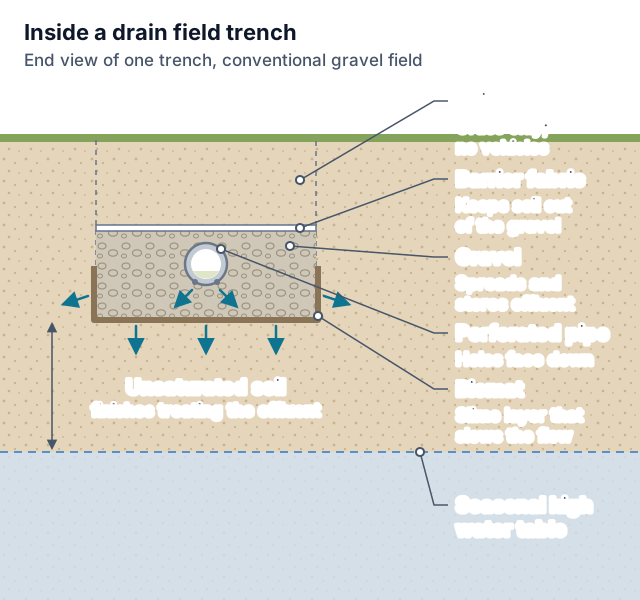
- Separation from wet soil: under Rule 18E .0901(a), a trench needs a foot of naturally occurring soil beneath it before any limiting condition, and 18 inches above any soil wetness condition when Group I (sandy) soil makes up more than six inches of that separation. Rule .0504 lists seasonal high and perched water tables among the causes of a soil wetness condition, which the evaluator determines from field indicators in the soil.
- Interim hauling: when it is necessary to protect public health, Rule .1306(c)(3) has the health department or state Department require the owner to pump and haul sewage to an approved system for the time the repair takes, and the notice of violation must say so.
- Pumps: the schedule lists a $50 pump fee, and a system with a pump comes under the health department compliance inspections in Rule 18E .1301 Table XXXII, at the interval the table sets for that system type (see the permit notes).
Permits & Local Rules
- Older systems: Rule 18E .0102(a) keeps the 18E rules from applying to a system whose permit or equivalent approval was issued before January 1, 2024 unless design daily flow or wastewater strength increases (strength counts as increased only when the facility is or becomes a commercial facility and its wastewater meets the high-strength definition). A system that is malfunctioning under Rule .1303(a)(2) must follow 18E, Rule .0206 (existing system approvals) still applies to systems whose operation permit or equivalent predates January 1, 2024, and Rule .0102(f) applies the Section .1300 operation and maintenance rules to every system. When a system installed on or after July 1, 1977 is repaired, expanded or modified without an increase in wastewater strength, Rule .0102(g) lets existing components stay as they are unless they are crushed, broken, damaged or otherwise unusable or ineffective so that they will not function as designed; every component must still meet the setbacks. For a system installed before July 1, 1977, Rule .0102(h) applies the same allowance except that setbacks to drinking water wells may not be reduced and setbacks to surface waters may not be reduced by more than 50 percent.
- Best professional judgement: Rule 18E .1306(c)(2) lets the owner ask, on a form provided by the state (posted on the On-Site Water Protection Branch's 18E resources page), that the authorized agent, AOWE or engineer use best professional judgement to develop a repair that should let the system function in compliance with Rule .1303(a)(1). The agent, AOWE or engineer documents on the form which rule provisions are being altered. The owner is liable for any damage caused by a system repaired this way and must agree in writing to all terms and conditions set by whoever developed the repair, including any operation and maintenance requirements, and that agreement is attached to the Construction Authorization, operation permit, Notice of Intent or authorization to operate. The method may not be used when well setbacks would fall below Rule .0601, when surface-water setbacks would be cut by more than 50 percent, or when there is no reasonable expectation the repaired system will eliminate public health hazards. Rules .1306(g) and (h) separately allow best professional judgement for malfunctioning systems installed before July 1, 1977, and for a pre-1977 disposal method that has been in continual use as the facility's sole source of wastewater disposal.
- Private soil evaluations: G.S. 130A-335(a1) lets a licensed soil scientist evaluate soil conditions and site features on a site not served by an approved wastewater system where a repair is necessary, and lets a licensed geologist evaluate the repair area for geologic and hydrogeologic conditions. Under (a2), those evaluations are used in developing the repair's design and must be approved by the permitting authorities, provided the evaluation stays within the scope of the license and the evaluator carries errors and omissions liability insurance from an insurer licensed under Chapter 58 in an amount commensurate with the risk. Johnston's schedule lists a repair under G.S. 130A-335(a2) at no charge.
- Pump inspections: Environmental Health says the state requires it to inspect every system that uses an effluent pump every five years, mailing a letter first and a report afterward. The county page cites “18E .1365,” but current 18E has no such rule; Section .1300 ends at Rule .1307. The schedule is Table XXXII of Rule .1301, which covers systems installed or repaired after July 1, 1992, plus all Type V and VI systems, and sets the interval by system type: it lists five-year entries for a system with a single pump or siphon (Type IIIb), with the owner or a certified operator as the management entity, but a three-year health department inspection for LPP distribution (Type IVa) and for a system with more than one pump or siphon (Type IVb), each managed by a private certified operator or a public management entity with a certified operator. The county's five-year wording therefore matches only some rows of the table; owners can confirm which row covers their system with Environmental Health. For Type IIIb and IIIh systems only, Rule .1305(d) lets a health department give the owner the option of having a private management entity, who is not the owner, perform the on-site compliance inspection under Table XXXII instead of the department; that entity must give the owner and the department a written compliance inspection report every five years documenting that the system complies with 18E and with the performance standards and conditions in the operation permit or authorization to operate.
Local Conditions
- Soil survey: NRCS Soil Data Access records for survey area NC101 (Johnston County) include map units named for Rains, Lynchburg, Goldsboro and Norfolk soils, among others, and labels its Bibb, Chewacla and Wehadkee units frequently flooded.
- Rains: poorly drained soils of middle and upper Coastal Plain flats, depressions and Carolina bays, with the seasonal high water table 0 to 12 inches below the surface from December to April.
- Lynchburg: somewhat poorly drained, with the seasonal high water table 6 to 18 inches deep from November to April.
- Goldsboro: moderately well drained, with the seasonal high water table 18 to 30 inches deep from December to April and no flooding or ponding.
- Norfolk: very deep and well drained, with the seasonal high water table 40 to 72 inches down from January to March.
- Wehadkee: a series established in Johnston County in 1911, made up of very deep, poorly and very poorly drained flood-plain soils; NRCS notes that most areas are frequently flooded.
- Rain: the Smithfield station (USC00317994) has a 1991-2020 annual precipitation normal of 49.37 inches, per NOAA.
Communities Served
Smithfield · Clayton · Selma · Benson · Four Oaks · Kenly · Princeton · Pine Level · Wilson's Mills · Archer Lodge · Micro
Emergency Response Expectations
Sewage on the ground or backing into the house is a malfunction under Rule 18E .1303, and the owner must notify Johnston County Environmental Health, the local health department here; its repair permit carries no charge on the July 1, 2026 schedule. Requests sent through this site go to independent local septic companies, and timing depends on which one takes the work.
Johnston County FAQs
Is a septic repair permit really free in Johnston County?
Yes for the repair line: the schedule effective July 1, 2026 lists Septic Repair at no charge. Upgrading or replacing an existing system is listed separately at $250, and an installation or re-inspection at $100, so confirm with Environmental Health which line your job falls under.
What counts as a malfunctioning septic system under North Carolina rules?
Rule 18E .1303(a)(2) calls a system malfunctioning when sewage or effluent discharges to the ground surface, surface waters or groundwater; backs up into the building, its drains, the collection system, the tank freeboard or the distribution system; or stands within three inches of finished grade over one or more trenches in two or more observations at least 24 hours apart and more than 24 hours after rain. Needing the tank emptied more often than once a month to prevent those conditions also counts. Once that happens, the owner has to notify the local health department, plus the PE or AOWE for a system permitted under an EOP or AOWE permit.
Can a private professional evaluate or design my repair instead of the county?
Yes, through routes the statutes set out: a licensed soil scientist's evaluation under G.S. 130A-335(a1) and (a2), an AOWE (Authorized On-Site Wastewater Evaluator) permit under G.S. 130A-336.2, or an Engineered Option Permit under G.S. 130A-336.1. Each has its own conditions, so read the statute or ask Environmental Health first. Johnston's schedule lists $35 to file under the EOP or AOWE option.
What happens if the field can't be repaired at all?
Rule 18E .1306(f) bars further use of a nonrepairable dispersal field and requires the owner to abandon the system under Rule .1307: a septage management firm permitted under G.S. 130A-291.1 removes the tank contents; the tanks are removed, collapsed or otherwise made unable to hold liquid, and backfilled; and electrical parts are de-energized and above-ground parts removed. Where no repair option exists, Rule .1306(d) lets the health department permit a permanent pump-and-haul system on an application meeting that rule's conditions.
Sources
- Johnston County Environmental Health: On-site wastewater (septic systems)
- Johnston County Environmental Health: Fee schedule (effective July 1, 2026)
- Johnston County Environmental Health: Application for septic system and well
- Johnston County Environmental Health: Find a septic or well permit
- G.S. 130A-335: Wastewater collection, treatment and disposal
- G.S. 130A-336.1: Engineered option permit
- G.S. 130A-336.2: Authorized On-Site Wastewater Evaluator option
- 15A NCAC 18E (OAH): Rules .0102, .0901, .1301, .1303, .1305, .1306 and .1307
- NC DHHS On-Site Water Protection Branch: 18E resources (best professional judgement form)
- USDA NRCS Soil Data Access: map units for survey area NC101 (query saved)
- USDA NRCS: Rains soil series
- USDA NRCS: Lynchburg soil series
- USDA NRCS: Goldsboro soil series
- USDA NRCS: Norfolk soil series
- USDA NRCS: Wehadkee soil series
- NOAA NCEI: 1991-2020 annual precipitation normal, Smithfield (USC00317994)
- U.S. Census Bureau: 2020 North Carolina places by county
Last reviewed 2026-11-04
Nearby Counties
Services Available in Johnston County
Drain Field Replacement
A failed drain field usually requires a new field on fresh soil, sized to current code. Connect with local licensed installers for site evaluation and quotes.
Learn more →Drain Field Repair & Rejuvenation
Many slow or soggy drain fields can be repaired for $1,000–$5,000 when the problem is a broken pipe, a failed D-box, or clogged laterals rather than worn-out soil.
Learn more →Perc Test & Site Evaluation
A perc or soil test tells the designer how fast your soil accepts effluent, which sets field size and type. Expect $600–$2,000.
Learn more →Aerobic (ATU) Spray & Drip Field Installation
Where soil is too tight, shallow or wet for a conventional field, the answer is usually an ATU that discharges to a spray field or drip lines. $10,000–$20,000+.
Learn more →Free Tools Before You Call
Ballpark the cost or narrow down the problem before talking to a Johnston County provider.
Need help in Johnston County, NC?
Send the short form — urgent requests get priority routing.