Drain Field Replacement Cost (2026)
Replacing a septic drain field typically costs $3,000 to $15,000, and the average is about $7,900 (HomeGuide, Dec 2025). Conventional gravel fields sit at the low end. Mound, drip and aerobic systems needed on clay, shallow rock or high-water-table lots run $7,000–$20,000 or more for the field, and $10,000–$40,000+ when a treatment unit is added. Budget separately for a soil test ($600–$2,000) and permits ($250–$2,300).
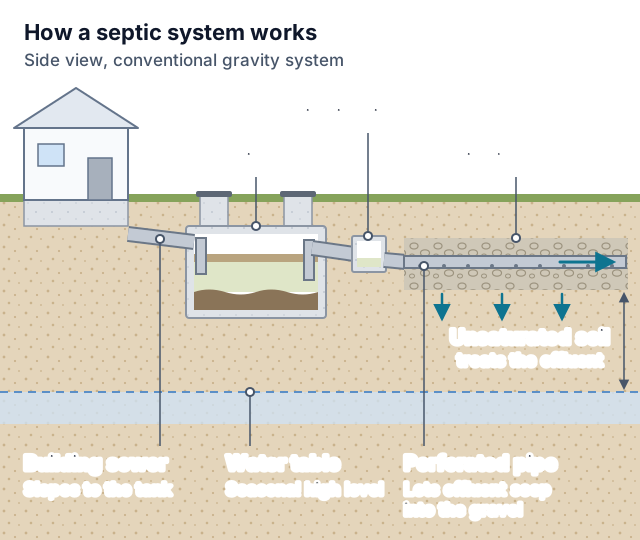
A drain field (also called a leach field or absorption field) is the part of a septic system that returns treated effluent to the soil. It fails when the soil beneath it seals with biomat, when pipes are crushed or clogged, or when the field is simply undersized for current use. Unlike a tank, a field usually can't be pumped back to health. Once the soil stops accepting water, the fix is a new field on fresh ground, sized to today's code.
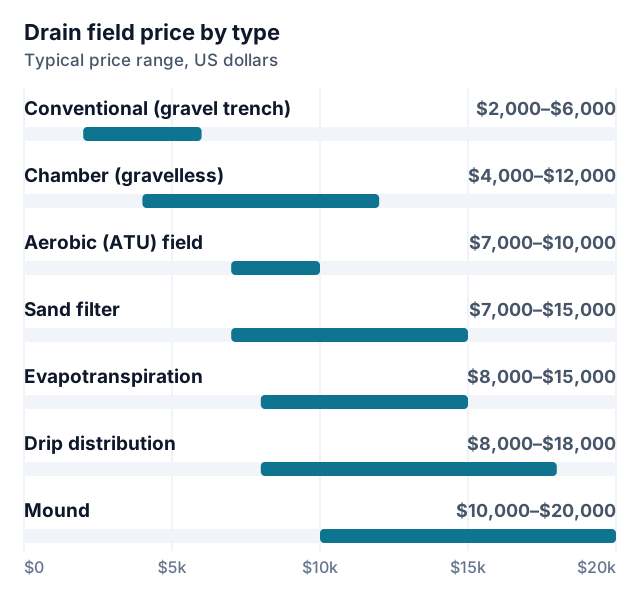
Three things decide what you pay: the field type your soil allows, the size your state's rules require, and local permit and design costs. National averages hide big local swings. In Central Texas, for example, 84–85% of 2025 permits in Bell and McLennan counties were for spray systems, not conventional trenches (TCEQ 2025 ATC report). Use the calculator below to size your field, then compare the ranges by type.
Typical national range
$3,000 – $15,000
avg $7,900 (HomeGuide)
Cost breakdown
| Item | Typical range | Notes |
|---|---|---|
| Conventional (gravel trench) | $2,000 – $6,000 | |
| Chamber (gravelless) | $4,000 – $12,000 | HomeAdvisor chamber system $5,000–$12,000 |
| Aerobic (ATU) drain field | $7,000 – $10,000 | |
| Sand filter | $7,000 – $15,000 | theseptic.guide |
| Evapotranspiration | $8,000 – $15,000 | |
| Drip distribution | $8,000 – $18,000 | HomeAdvisor drip system avg $13,000 |
| Mound | $10,000 – $20,000 | HomeAdvisor avg $15,000 |
| Tank + field together | $4,500 – $20,000 | |
| Relocate the field | $5,500 – $21,500 | |
| Perc / soil test | $600 – $2,000 | Angi avg ~$1,300 |
| System design / engineering | $500 – $1,500 | |
| Permit | $250 – $2,300 | envelope: HomeGuide low, HomeAdvisor high |
| Tank pumping before work | $292 – $565 | Angi |
| Excavation | $1,500 – $6,300 | HomeAdvisor |
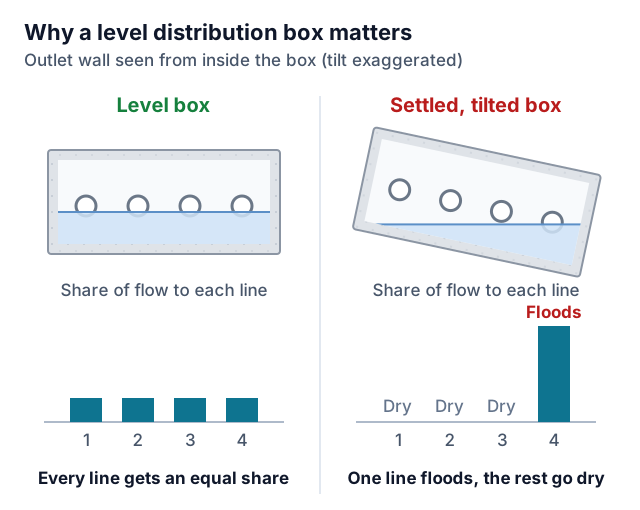
| Distribution box | $500 – $1,500 | |
| Abandon old system (permit) | $100 – $250 | |
| Tree removal | $200 – $2,000 | per tree |
| Landscaping restoration | $500 – $3,000 | |
| Regrading after the job | $1,000 – $3,300 | Angi |
What changes the price
Providers quote their own work — these are the factors that consistently move the number.
- Soil and perc results. Tight clay or shallow rock rules out conventional trenches. Most acreage in all six of our starter counties is rated 'very limited' for absorption fields by USDA NRCS (61–89% by county; see local pages).
- Required size. Bigger homes and slower soils need more area. In Texas a 3-bedroom home on Class III soil needs 1,200 sq ft of absorptive area (TCEQ Table VIII example). The calculator does this math.
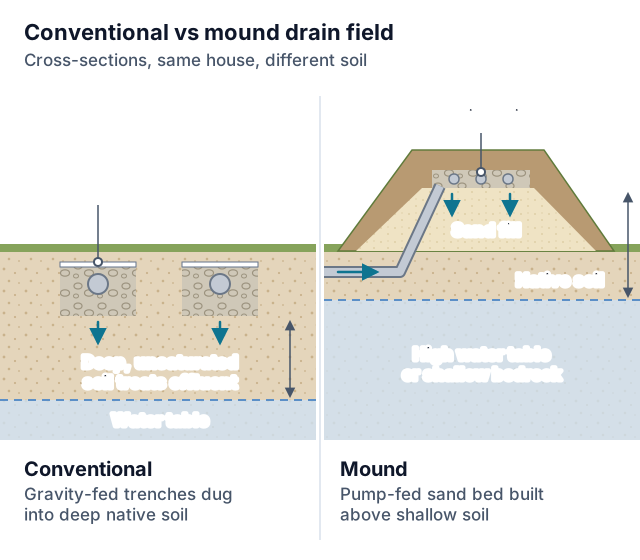
- Field type mandated by code or site. A conventional trench field runs $2,000–$6,000 vs $10,000–$20,000 for a mound (HomeGuide), so the type your soil allows is usually the biggest swing.
- Permits and local rules. County fees range from $50 (Lake County FL repair permit) to $710 (aerobic permits in McLennan and Bell counties, TX). Florida nitrogen rules can require an enhanced system on replacement in springs protection zones.
- Access and site restoration. Excavation, trees, driveways and landscaping add $500–$5,000+.
- Replacing the tank too. Tank + field runs $4,500–$20,000 (HomeGuide).
Whole aerobic systems
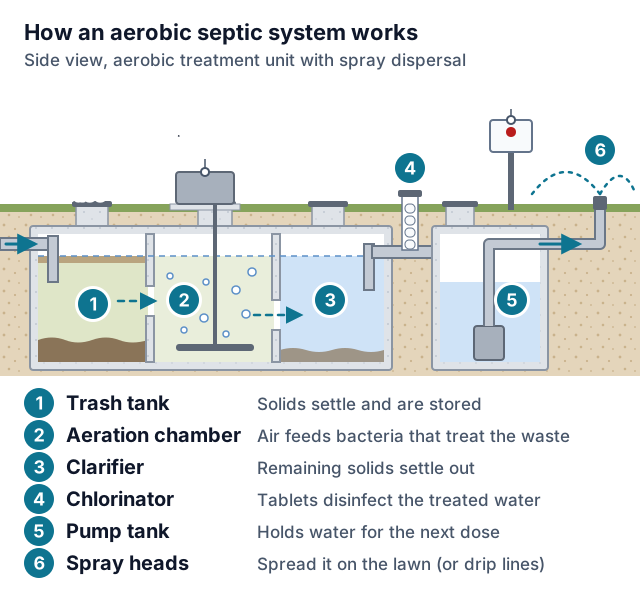
Whole aerobic systems (treatment unit + field): $10,000–$20,000 (HomeAdvisor, Jun 2026) vs $20,000–$40,000+ (HomeGuide septic system cost, Sep 2025). We show both because the sources disagree.
Labor
Labor is typically 60% or more of the bill (HomeGuide; HomeAdvisor says 50–70%).
Why the number of bedrooms changes the price
Health departments size drain fields by design flow, which most state rules base on the number of bedrooms. More bedrooms means more trench, more media and more excavation. Your county health department can tell you the local sizing rule, and the calculator above applies the Texas, North Carolina and Florida tables.
Hidden costs to budget for
Budget for a perc test and engineered design, permit fees, tank pumping, removal of the failed field if its area must be reused, and restoring the lawn or driveway the excavator crosses. Published ranges: perc or soil test $600–$2,000 (HomeGuide), permit $250–$2,300 (HomeGuide and HomeAdvisor), pumping before work $292–$565 (Angi), excavation $1,500–$6,300 (HomeAdvisor) and regrading afterward $1,000–$3,300 (Angi).
Drain field care checklist
Routine care: have the system inspected by a septic service professional at least every three years, and pump the tank on schedule. Household tanks are typically pumped every three to five years (EPA). Keep a note of when it was last pumped and when it is next due.
Protect the field: don't park or drive on it; plant trees far enough away that roots stay out (ask your septic professional what that distance is); and keep roof drains, sump pumps and other rainwater drainage away from the drain field area (EPA).
If you plan to replace it: find out who issues septic permits in your state and county, ask whether a soil evaluation or perc test is required and who may perform it (see our perc test cost guide), and get at least three written, itemized quotes. Your state and county rules come first.
Repair or replace?
Not every failing field needs replacement. Jetting ($200–$1,400, HomeGuide), a new distribution box ($500–$1,500, HomeAdvisor) or soil fracturing ($1,000–$3,000, theseptic.guide) can restore a field whose soil still drains. Repair or rejuvenation typically costs $1,000–$5,000 (HomeGuide).
How location changes the number
McLennan, TX: $510 conventional / $710 aerobic / $285 minor repair (+$10 state). 85% of 2025 permits were spray systems.
Bell, TX: $610 standard / $710 professional design. Permit required on any acreage.
Union, NC: $400 application + $200–$1,200 authorization; repair $100. NRCS cites depth to bedrock on ~300,000 of 409,139 acres.
Johnston, NC: $600–$700 new; repair no charge. Water table within 30 cm on ~29% of acreage (NRCS).
Lake, FL: $75 new / $50 repair (county DOH schedule). Springs BMAP areas; sandy, wet soils.
Hernando, FL: Weeki Wachee PFA: replacements must reduce nitrogen ≥65%.
Frequently Asked Questions
How much does it cost to replace a drain field in 2026?
Typically $3,000–$15,000, about $7,900 on average (HomeGuide). Angi's average job is about $7,000.
Why is a mound or aerobic system so much more?
It is engineered for soil that can't treat effluent on its own. Mound fields run $10,000–$20,000. Aerobic systems run $10,000–$20,000 (HomeAdvisor) to $20,000–$40,000+ (HomeGuide).
How long does replacement take?
3–7 days on site (HomeGuide). With permits and design, theseptic.guide says 4–12 weeks.
How long will the new field last?
20–25 years on average (HomeGuide); Angi says about 20. EPA advises inspecting the system every three years and pumping typically every three to five years. Overloading with water, grease or wipes shortens field life.
Does homeowners insurance cover drain field replacement?
Rarely. Most policies exclude wear and gradual failure. Damage from a sudden event may be covered.
Are there grants for drain field replacement?
USDA Rural Development's Section 504 program offers repair loans and grants to qualifying low-income rural homeowners, and some states run septic repair programs. Check with your county health department.
Can I replace just part of a drain field?
Sometimes. Adding or replacing laterals is billed by the foot ($20–$45/LF for leach lines, HomeGuide), and some counties treat field expansions as minor repairs (McLennan County: $285).
Estimates only — independent local providers quote their own pricing. Data last reviewed 2026-10.
Sources
- HomeGuide — Drain/Leach Field Replacement Cost (Dec 2025) (third-party estimate)
- theseptic.guide — Drainfield Replacement Cost (Mar 2026) (third-party estimate)
- HomeAdvisor — Septic System Installation Cost (Jun 20, 2026) (third-party estimate)
- HomeGuide — Septic Tank System Cost (Sep 22, 2025) (third-party estimate)
- Angi — How Much Do New Drain Fields Cost? (Jul 8, 2026) (third-party estimate)
- Angi — Septic Tank Pumping Cost (Oct 14, 2026) (third-party estimate)
- EPA — How to Care for Your Septic System
- USDA Rural Development — Single Family Housing Repair Loans & Grants (Section 504)
- TCEQ 2025 Authorized Agent ATC report
- TCEQ OSSF rules compilation RG-472
Related Resources
Prefer to just talk to someone?
Send the short form — we'll route you to an independent local pro.