Drain Field Repair in Hernando County, FL
Drain field replacement typically runs $3,000–$15,000 nationally, per our cost guide. Independent local pros serving Brooksville, Spring Hill, Timber Pines and nearby communities. Describe the problem and we'll route your request — free, no obligation.
- Replacement typically $3,000–$15,000 (avg $7,900, HomeGuide)
- Mound, drip and aerobic systems $10,000–$20,000+
- Free quotes from licensed local installers
Fast response from independent local providers. No obligation.
Typical national cost$3,000 – $15,000Cost guide →Local Help in Hernando County, FL
Drain field repairs in Hernando County are permitted by the Florida Department of Health in Hernando County (DOH-Hernando). The Florida Department of Environmental Protection (DEP) has been responsible for implementing the state's septic statutes and rules since July 1, 2021, but DOH-Hernando's onsite sewage page says that under the Clean Waterways Act of 2020 county health department offices go on permitting and inspecting septic systems, and DEP's permitting FAQ (last modified September 24, 2026) lists Hernando among the counties where the local health department issues permits. Its page requires a DOH-Hernando permit for every proposed new installation, repair and modification, and for approvals of existing systems.
Rule 62-6.002(51) of the Florida Administrative Code treats as a repair any replacement of, or modification or addition to, a failing system that is necessary for the system to function in accordance with its design or must be made to eliminate a public health or pollution hazard, so replacing or enlarging a failing system's drainfield falls inside it. The definition leaves out like-kind servicing or replacement of mechanical or electrical parts of an approved system, minor structural fixes to a tank or distribution box, a broken tank lid, pumping out any tank or fitting an approved outlet filter where the drainfield is left undisturbed, an owner's non-prohibited additive put in through the building plumbing, and a drip emitter line splice that eliminates no emitter; a treatment method meant to improve part of the system or make it last longer does count. Rule 62-6.003(1)(e) says all repairs require a system construction permit, and Rule 62-6.015 allows repairs to a failing system only with the Department's prior knowledge and written approval.
On June 27, 2025, DEP signed final orders adopting two springs restoration plans whose boundaries take in Hernando land. The Weeki Wachee basin management action plan (BMAP) spans 200,474 acres of southern Hernando County, including a portion of the City of Brooksville, and northern Pasco County; the Homosassa and Chassahowitzka Springs Groups BMAP spans 340,609 acres of southern Citrus County and northern Hernando County. Their priority focus areas (PFAs) cover 90,415 and 77,732 acres respectively; inside them, a repair permit brings in the nitrogen policy in the FAQs below.
Hernando County Service Details
What providers in this area actually see: coverage, common jobs, local pricing factors, and rules worth knowing.
Service Area Notes
- The communities below are places in the Census Bureau's 2020 file for Hernando County: Brooksville as a city, the rest as census designated places. The file also codes Weeki Wachee as a city, but Chapter 2020-196, Laws of Florida (approved June 9, 2020), abolished the City of Weeki Wachee and passed its assets and legitimate liabilities to the county.
- Both springs plans point to DEP's PFA and BMAP boundary map, searchable by street address; DEP's springs page sends property questions to the permitting authority, here DOH-Hernando.
- Hernando County Utilities Department presents its Septic to Sewer Conversion Project as its answer to the state-mandated Onsite Sewage Treatment and Disposal System Remediation Plan requirement for Weeki Wachee Springs.
Common Jobs in Hernando County
- Drainfield replacement under a DOH-Hernando repair permit
- Added drainfield for a 1983-or-later system overloaded hydraulically
- Alternative repairs such as air injection (DEP keeps a non-objection list), with the added application details Rule 62-6.015(3) requires
- Nitrogen-reducing installations on PFA repair permits
What Drives Pricing Here
- State fees: Rule 62-6.030, amended effective June 8, 2026, sets $50 for an application with existing system and system repair evaluation, $55 for a new, modification or repair permit (or a permit application amendment), a $5 research/training surcharge on new and repair permits, $75 for the initial system inspection, $50 per reinspection and $115 for a site evaluation by the Department. DEP's FAQ adds that the local health department sets the total, any county fees included, based on the system type and the services requested. Under Rule 62-6.003(1)(d), no fee is charged for a repair permit issued within 12 months of the system's final installation approval.
- Drainfield size: Rule 62-6.015(10) bars installing less drainfield than the system had, except where subsection (7) applies because the standard criteria cannot be met. For a system permitted on or after January 1, 1983 that failed from excessive hydraulic loading, paragraph (6)(b) lets the original drainfield stay in service but requires added drainfield, making the total 50 percent larger than originally permitted or compliant with Rules 62-6.008 and 62-6.009 sizing, whichever is larger. Paragraph (6)(h) requires dosing when total drainfield area exceeds 1,000 square feet or the tank sits too low for gravity flow.
- Spoil: Rule 62-6.015(6) bars using aggregate and soil from drainfield-repair spoil in the repair in any manner; undamaged infiltration units, pipes and mechanical components may be reused on the original site. Disposal of the spoil follows that subsection's conditions; read them or ask DOH-Hernando before the old field is dug out.
- Nitrogen-reducing equipment: DEP's springs page names in-ground nitrogen-reducing biofilters and Florida-approved nitrogen-reducing aerobic treatment units (NSF 245-certified) and performance-based treatment systems as meeting the enhanced standard; Rule 62-6.030 sets $100 for the biennial operating permit of the last two. Hernando County's Septic Upgrade Incentive Program has closed, its page says, with all grant funding expended.
Permits & Local Rules
- Applying: Rule 62-6.015(1) has the owner or lessee, directly or through an agent, request a repair permit before starting the repair, applying on Form DEP 4015 with the exhibits and fees; the permit is issued on Form DEP 4016. Paragraphs (1)(a)-(f) list what the application must show, and subsection (2) puts the site evaluation at the owner's or lessee's expense. DOH-Hernando caps site and floor plans at 11 by 17 inches.
- Timing: Rule 62-6.015(5) directs the Department to make every effort to issue a repair permit within 2 working days after it receives the application. The permit is valid for 90 days from issuance, and it is extended for one further 90-day period if the system is maintained so that it does not create a sanitary nuisance.
- Inspection: before manhole covers are sealed or work is covered with fill, Rule 62-6.003(2) requires the person installing, repairing, modifying, replacing, abandoning or constructing the system to notify the Department or an authorized private provider inspector to schedule and complete a construction inspection, which must be performed onsite in person. For a repair, Rule 62-6.015 has the Department check that the absorption surface is at least six inches above the wet season high water table, that the work followed the repair application and that the site is free of sanitary nuisance conditions. DOH-Hernando takes inspection requests online through HernandoInspection.com and says a certified provider, not the homeowner or occupant, should make them. Section 381.0065(8), F.S., lets the owner, or a contractor with the owner's written authorization, hire a private provider for the inspection, an option DEP dates to July 1, 2022; DEP's private provider page sets out who qualifies, the forms and deadlines, and that master septic tank contractors may not do construction inspections on their own repair.
Local Conditions
- Nobleton soils, a series NRCS established in Hernando County in 1976, are deep and somewhat poorly drained; in most years their perched water sits 20 to 40 inches below the surface for 1 to 4 months of the summer rainy season. Masaryk soils, also established here in 1976, are very deep and moderately well drained, with a perched water table at 40 to 60 inches for 1 to 2 months and at 60 to 72 inches for 2 to 4 months in most years.
- Near the coast, the Aripeka series (type location close to Hernando Beach) is moderately deep and somewhat poorly drained over soft and hard limestone, with the hard rock (R horizon) roughly 23 to 40 inches down. Its description places the water table at 18 to 30 inches for 2 to 6 months, and at 30 to 60 inches for 6 months or more.
- Rainfall: NOAA's 1991-2020 normals for the Brooksville Chin Hill station (USC00081046) are 51.94 inches of precipitation a year and 24.25 inches for June through August.
- Springs: the Southwest Florida Water Management District describes the Weeki Wachee springshed as approximately 240 square miles across northern Pasco and southwest Hernando counties. The Weeki Wachee BMAP counts approximately 37,239 known and likely septic systems in its PFA (FLWMI 2023 data) and attributes 49% of the pollutant loading in the springshed area to septic systems.
Communities Served
Brooksville · Spring Hill · Timber Pines · Hernando Beach · Brookridge · Ridge Manor · Masaryktown · Nobleton · Istachatta · Aripeka · Bayport · Pine Island
Emergency Response Expectations
Rule 62-6.002(25) defines failure as a condition that keeps a system from working in a sanitary manner and sends untreated or partially treated wastewater onto the ground surface or into surface or ground water, or keeps building plumbing from discharging properly. Repairing a failing system needs DOH-Hernando's prior written approval under Rule 62-6.015; its onsite sewage page lists how to reach the office.
Hernando County FAQs
Does a drain field repair permit inside a springs PFA require a nitrogen-reducing system?
Under Appendix E of both 2025 plans, the policy for existing systems covers the PFA on all lot sizes: when any Chapter 62-6 construction permit is needed to repair, modify or replace such a system, a DEP-approved enhanced nutrient-reducing system meeting 65% nitrogen reduction must be installed, unless the OSTDS permit applicant provides documentation that a sewer connection to the property is planned and funded, and that structures on the lot will be connected. Section 2.5.2 of each plan also accepts a different wastewater system reaching at least 65% nitrogen reduction and makes an exception where s. 381.00655, F.S., requires a central sewer connection; the executive summaries put it as connecting to sewer if available, otherwise upgrading or replacing the system, unless sewer connections will be available through a BMAP-listed project. A repair qualifying as a new-system permit is handled under the plans' new-system rules, which require a system achieving at least 65% nitrogen reduction where central sewer is unavailable on any lot in the PFA or on lots of one acre or less elsewhere in the BMAP. Appendix E sets a deadline of no later than 20 years after BMAP adoption for systems under the policy, while the executive summaries say 2038; ask DOH-Hernando how it applies to your lot.
Does a system that needs repair have to connect to available sewer?
Section 381.00655(1)(b), F.S., requires the owner of a system that needs repair or modification to function in a sanitary manner, or to comply with ss. 381.0065-381.0067 or their rules, to connect to an available publicly owned or investor-owned sewer within 90 days after written notification from the department. In hardship cases, on the owner's request, the department may approve one extension of no more than 90 days, and the paragraph does not allow creating or keeping a sanitary nuisance. Section 381.0065(2)(a) defines when a sewer counts as available, with separate tests by property type and flow. Subsection (2) lets the sewer system, with department approval, waive a connection it finds not required in the public interest due to public health considerations, and adds hardship-payment and variance provisions; read it or ask the utility.
How close to the water table can a repaired drainfield sit?
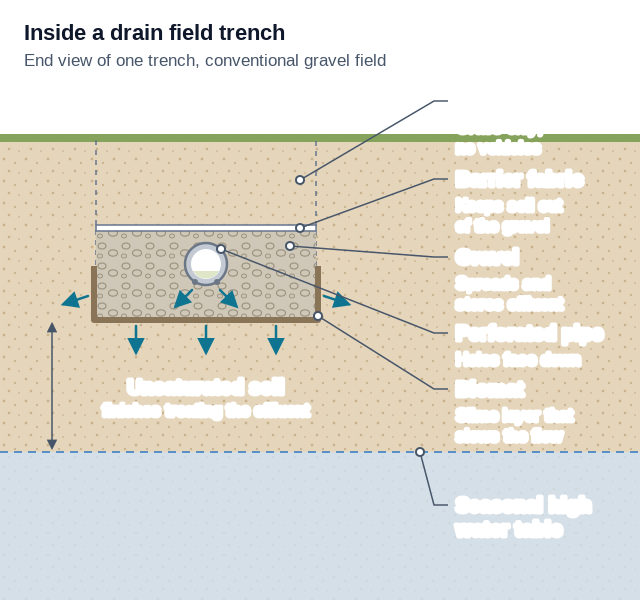
Table V in Rule 62-6.015 sets 24 inches between the bottom of the absorption surface and the wet season water table as the current required separation. Where a repair cannot meet it, the absolute minimum for systems originally permitted from January 1, 1983 on is the greater of the existing elevation (if at least 12 inches) or 12 inches; for older systems it is the greatest of the maximum separation attainable, the original separation (if at least 6 inches) or 6 inches. Subsection (4) bars alternative repair methods where the absorption surface is within 6 inches of the wet season high water table, requiring removal and replacement, and subsection (7) says nothing in the rule allows a drainfield to remain in the wet season water table.
Does the septic tank have to be replaced along with the drain field?
Not under Rule 62-6.015(6)(f) if the health unit finds the tank structurally sound, built of approved materials and within two tank sizes of the effective capacity Table II requires. A tank that stays must be pumped, and a solids deflection device must be added to its outlet if it lacks one.
Sources
- DOH-Hernando: Onsite Sewage Disposal
- DEP: Onsite Sewage FAQ, Permitting
- DEP: Alternative Repair Methods
- DEP: Private Provider Inspections of OSTDS
- DEP: Springs Protection and BMAPs
- DEP: PFA and BMAP boundary map
- DEP: Weeki Wachee BMAP, June 2025
- DEP: Weeki Wachee BMAP final order
- DEP: Homosassa and Chassahowitzka BMAP, June 2025
- DEP: Homosassa and Chassahowitzka BMAP final order
- Rule 62-6.002, F.A.C.
- Rule 62-6.003, F.A.C.
- Rule 62-6.015, F.A.C.
- Rule 62-6.030, F.A.C.
- Section 381.0065, F.S.
- Section 381.00655, F.S.
- Laws of Florida ch. 2020-196
- U.S. Census Bureau: 2020 Florida places by county
- USDA NRCS: Nobleton series
- USDA NRCS: Masaryk series
- USDA NRCS: Aripeka series
- NOAA NCEI: 1991-2020 normals, USC00081046
- SWFWMD: Weeki Wachee Springs
- Hernando County Utilities: Septic to Sewer
- Hernando County SUIP page
Last reviewed 2026-11-10
Nearby Counties
Services Available in Hernando County
Drain Field Replacement
A failed drain field usually requires a new field on fresh soil, sized to current code. Connect with local licensed installers for site evaluation and quotes.
Learn more →Drain Field Repair & Rejuvenation
Many slow or soggy drain fields can be repaired for $1,000–$5,000 when the problem is a broken pipe, a failed D-box, or clogged laterals rather than worn-out soil.
Learn more →Perc Test & Site Evaluation
A perc or soil test tells the designer how fast your soil accepts effluent, which sets field size and type. Expect $600–$2,000.
Learn more →Aerobic (ATU) Spray & Drip Field Installation
Where soil is too tight, shallow or wet for a conventional field, the answer is usually an ATU that discharges to a spray field or drip lines. $10,000–$20,000+.
Learn more →Free Tools Before You Call
Ballpark the cost or narrow down the problem before talking to a Hernando County provider.
Need help in Hernando County, FL?
Send the short form — urgent requests get priority routing.