Drain Field Repair in Lake County, FL
Drain field replacement typically runs $3,000–$15,000 nationally, per our cost guide. Independent local pros serving Clermont, Leesburg, Eustis and nearby communities. Describe the problem and we'll route your request — free, no obligation.
- Replacement typically $3,000–$15,000 (avg $7,900, HomeGuide)
- Mound, drip and aerobic systems $10,000–$20,000+
- Free quotes from licensed local installers
Fast response from independent local providers. No obligation.
Typical national cost$3,000 – $15,000Cost guide →Local Help in Lake County, FL
A failed drain field in Lake County is repaired under a permit from the Florida Department of Health in Lake County (DOH-Lake). Florida's Department of Environmental Protection (DEP) writes the rules, and the statewide DOH septic page says DEP has been in charge of enforcing Florida's septic laws and rules since July 1, 2021. In its permitting FAQ, DEP lists Lake among the counties where the county health department's Environmental Public Health program issues permits.
Section 381.0065(4) of the Florida Statutes says a person may not construct, repair, modify, abandon or operate a septic system without first obtaining a permit approved by DEP, and that a repair permit is valid for 90 days after issuance. Rule 62-6.003(1)(e) adds that all repairs require a system construction permit, and Rule 62-6.002(51) defines what is and is not a repair (see the FAQ below).
Lake County Service Details
What providers in this area actually see: coverage, common jobs, local pricing factors, and rules worth knowing.
Service Area Notes
- The towns listed below are incorporated places and census-designated places that the Census Bureau's 2020 place-by-county file assigns to Lake County.
- Sewer instead of repair: under s. 381.00655(1)(b), F.S., the owner of a system that needs repair or modification to work in a sanitary manner, or to meet ss. 381.0065-381.0067 or their rules, must connect to an available publicly owned or investor-owned sewer within 90 days after written notification from DEP; in hardship cases DEP may, on the owner's request, approve one extension of not more than 90 days, and no sanitary nuisance is allowed meanwhile. Subsection (2) allows two exceptions to that duty. Under (2)(b), a publicly owned or investor-owned sewer system may, with DEP's approval, waive mandatory connection if it determines that connecting is not required in the public interest due to public health considerations. Under (2)(c), a local government or water and sewer district operating a central sewer under s. 153.62 may, but is never required to, grant a variance to the owner of a DEP-permitted performance-based system that is functioning properly and meeting its operating-permit conditions. Whether either exception fits a property is for the sewer provider and DOH-Lake to answer.
- DEP's interactive basin plan map, which the Wekiwa plan says can be searched by street address, shows whether a parcel is inside a plan or priority focus area.
Common Jobs in Lake County
- Rebuilding a failed field in its original location: when a repair cannot meet the standards of subsection (6), Rule 62-6.015(7) has all available area assessed and the permit allow the largest drainfield that fits while the system stays above the wet-season water table, and it authorizes total removal and replacement in the original spot if there is no additional area to enlarge the system. Setbacks to wells, surface water bodies and other pertinent features that are already less than subsection (6) requires may not be reduced below the existing setbacks, and the Table V separation to the wet-season water table still applies
- Adding drainfield to a system permitted on or after January 1, 1983 that failed from excessive hydraulic loading: Rule 62-6.015(6)(b) keeps the original field in service and makes the combined field 50 percent larger than first permitted, or the size Rules 62-6.008 and 62-6.009 call for, whichever is larger
- Mound or filled drain fields, which Rule 62-6.009(3) says are used to overcome limits such as an elevated seasonal high water table, shallow permeable soil over slowly permeable soil, and shallow permeable soil over creviced or porous bedrock
- Jetting, air injection or chemical treatments, for which Rule 62-6.015(3) asks extra application details; subsection (4) bars them where the absorption surface is within 6 inches of the wet-season high water table and requires the field to be removed and replaced
- Enhanced nutrient-reducing upgrades when a repair, modification or replacement permit is needed inside the Silver Springs and Rainbow Springs basin plan boundary, unless the applicant documents a planned and funded sewer connection (see below)
What Drives Pricing Here
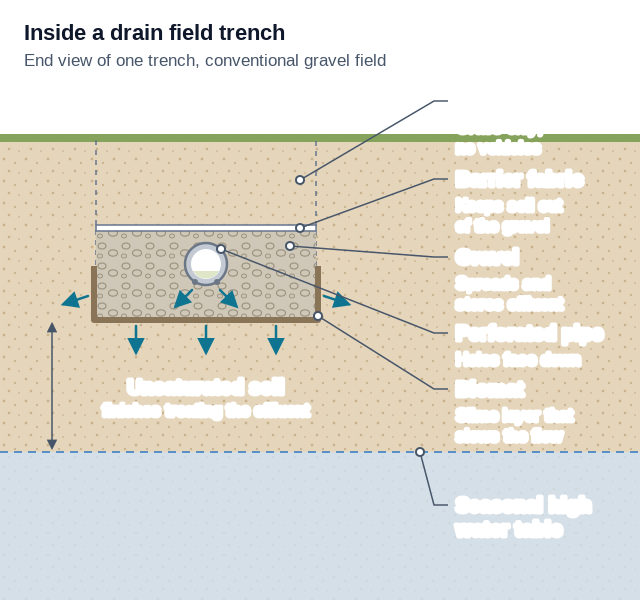
- Separation from the water table: Rule 62-6.015(6)(a) starts from the current setbacks and separations of Rule 62-6.005; where those cannot be met, Table V sets floors by the original permit date, keeping current setbacks first for the features with the highest protection factor. For the bottom of the absorption surface, the current figure is 24 inches; a system permitted from January 1, 1983 on may keep its existing elevation if that is at least 12 inches, with 12 inches as the floor, and a system permitted before 1983 needs the greatest of the maximum separation attainable, its original separation (if at least 6 inches) or 6 inches. No drainfield may remain in the wet-season water table (Rule 62-6.015(7)).
- Field size: Rule 62-6.015(10) says, except under subsection (7), a repair may not install less drainfield than the system had before. For residential systems installed before 1983, the rule's Tables VI and VII set minimum sizes when the old field cannot be reused.
- Spoil: Rule 62-6.015(6) bars reusing aggregate and soil dug from a failed field in the repair and sets conditions for disposing of it; read the rule or ask DOH-Lake before planning disposal.
- Tank: under Rule 62-6.015(6)(f) the tank may stay if the health unit finds it structurally sound, of approved materials and within two tank sizes of the Table II capacity, but it is pumped and gets an outlet solids deflection device if it lacks one.
- State fees (Rule 62-6.030, effective June 8, 2026) that can apply to a repair include $50 for application and existing system and repair evaluation, $55 for a permit or permit amendment for a new system, modification or repair, a $5 research and training surcharge on new and repair permits, $75 for the initial system inspection and $50 for each reinspection. DEP's FAQ says the county health department sets the total fee, including any county fees, and Rule 62-6.003(1)(d) charges no fee for a repair permit issued within 12 months of the system's final installation approval.
Permits & Local Rules
- The application: Rule 62-6.015(1) lists what the repair application and site plan must show, including the estimated wettest-season water table and a description of the failure; read the rule or ask DOH-Lake for the forms. Under subsection (2), the site evaluation is at the owner's or lessee's expense, by Department staff, a Florida-licensed engineer or another person qualified under Rule 62-6.004(3).
- Timing: under Rule 62-6.015(5), the Department makes every effort to issue a repair permit within 2 working days of receiving the application; the permit is valid for 90 days and is extended for one more 90-day period if the system is maintained so it does not create a sanitary nuisance.
- Inspection: Rule 62-6.003(2) requires whoever is repairing or replacing any part of a system to notify the Department or an authorized private provider inspector, and to schedule and complete a construction inspection, before sealing manhole covers or covering with fill. The private provider route has its own form and deadlines in Rule 62-6.003(3); ask DOH-Lake before using it.
- County fees: Lake County's adopted fiscal year 2027 fee schedule has OSTDS repair, modification and reinspection lines in its Florida Department of Health in Lake County section but prints no effective date, so those amounts are not quoted here. Confirm the total with DOH-Lake.
Local Conditions
- Silver Springs and Rainbow Springs: DEP's June 2025 basin plan is centered on Marion County, but its boundary reaches into Lake County and covers Fruitland Park and Lady Lake in whole or in part. Appendix E.1.2 applies its existing-system policy to every septic system inside the plan boundary: when a Chapter 62-6 construction permit is needed to repair, modify or replace one, a DEP-approved enhanced nutrient-reducing system meeting at least 65 percent nitrogen reduction must be installed unless the permit applicant provides documentation that sewer connection to the property is planned and funded and that structures on the lot will be connected. The plan's deadlines do not match: its executive summary says every system under the policy must include enhanced nitrogen treatment by 2038, while Appendix E.1.3, quoted in DEP's August 2026 requirements table, gives conventional systems until 20 years after plan adoption to meet enhanced nutrient-reducing requirements, install another wastewater system achieving at least 65 percent reduction or connect to central sewer. Ask DEP or DOH-Lake which applies to a given lot. Repairs that qualify as new system permits follow the plan's rules for new systems.
- Wekiwa Spring and Rock Springs: DEP's 2025 plan covers parts of Lake, Orange and Seminole counties. Its existing-system policy for repair, modification and replacement permits, with the same planned-and-funded sewer exception and the same deadline question in its Appendix E, applies only inside the plan's priority focus area, on lots of one acre or less (DEP's August 2026 table says lots less than one acre), and the plan's Figure ES-1 map draws that area east of the Lake County line. Both plans let local governments expand the requirement by ordinance.
- Soils: NRCS established the Apopka series in Lake County in 1970, and its type location is there. It is well drained, with rapid permeability in the sandy surface and subsurface layers, moderate permeability in the upper loamy subsoil and moderately slow permeability in the lower subsoil.
- Tavares, also typed in Lake County, is moderately well drained, and NRCS places its water table 42 to 72 inches below the surface during more than 6 to 10 months of most years. In Myakka flatwoods, another Lake County type soil, the water table rises to less than 18 inches deep during 1 to 4 months of most years. Table V of Rule 62-6.015 measures a repair's separation to the wet-season water table, which is why these readings matter for a replacement field.
- Rain: NOAA's 1991-2020 normals for the Lisbon, FL station (USC00085076) give 50.03 inches of precipitation a year.
Communities Served
Clermont · Leesburg · Eustis · Tavares · Mount Dora · Groveland · Minneola · Lady Lake · Umatilla · Fruitland Park · Howey-in-the-Hills · Mascotte · Montverde · Astatula · Sorrento · Mount Plymouth · Paisley · Astor · Altoona · Yalaha
Emergency Response Expectations
Rule 62-6.002(25) defines a failure as a condition that keeps a system from working in a sanitary manner and results in untreated or partially treated wastewater reaching the ground surface, surface water or ground water, or in building plumbing that does not discharge properly. Rule 62-6.015 says repairs to a failing system may be made only with the prior knowledge and written approval of the Department having jurisdiction, so contact DOH-Lake environmental health before any repair starts.
Lake County FAQs
Can I replace the drain field on my own house without a contractor?
Section 381.0065(4), F.S. bars anyone from contracting to construct, modify, alter, repair, service, abandon or maintain any part of a septic system without registration under part III of chapter 489. A property owner who personally builds, maintains or repairs the system serving his or her own owner-occupied single-family residence is exempt from registration for that work on that residence, but must still get every permit.
Our lot is in the Green Swamp. What does Lake County require?
Section 8.01.10.E of the county's land development regulations requires every lot owner with one or more septic tanks in the Green Swamp Area of Critical State Concern to have them cleaned and inspected at least once every five years under DOH-Lake's requirements; DOH-Lake requires the tank to be cleaned and the mound, drainfield and tank to be in good working order. As necessary, lot owners pay a fee assessed to cover the cost of the inspection program, the owner must make all repairs needed for compliance, the developer or owner must disclose these conditions to a buyer in the sales contract or deed, and the county's Code Enforcement Special Master may enforce the section if DOH-Lake receives no proof in time.
Does pumping the tank or fixing a lid count as a drain field repair?
Under Rule 62-6.002(51), a repair is replacing, modifying or adding to a failing system so it works as designed or to remove a public health or pollution hazard, and any treatment method meant to improve the system's function or extend its life counts as a repair. The definition excludes servicing or like-kind replacement of mechanical or electrical parts of an approved system, minor structural corrections to a tank or distribution box, an owner adding a non-prohibited additive through the building plumbing, pumping a tank or fitting an approved outlet filter where the drainfield is not disturbed, replacing a broken tank lid, and splicing a drip emitter line where no emitter is eliminated. Anything that is a repair needs a permit from DOH-Lake first.
Sources
- DOH in Lake County: Environmental Public Health
- Florida DOH: Onsite sewage and septic
- Florida DEP: Onsite sewage permitting FAQ
- Fla. Stat. s. 381.0065 (2026)
- Fla. Stat. s. 381.00655 (2026)
- Fla. Admin. Code R. 62-6.002
- Fla. Admin. Code R. 62-6.003
- Fla. Admin. Code R. 62-6.009
- Fla. Admin. Code R. 62-6.015 (repairs)
- Fla. Admin. Code R. 62-6.030 (fees, effective June 8, 2026)
- Florida DEP: ENR septic requirements by BMAP (August 2026)
- Florida DEP: Silver Springs and Rainbow Springs BMAP (June 2025)
- Florida DEP: Wekiwa Spring and Rock Springs BMAP and final order (2025)
- Lake County Code: Green Swamp, s. 8.01.10
- Lake County: Adopted FY 2027 fee schedules (no effective date)
- USDA NRCS: Apopka soil series
- USDA NRCS: Tavares soil series
- USDA NRCS: Myakka soil series
- NOAA NCEI: 1991-2020 normals, Lisbon, FL (USC00085076)
- U.S. Census Bureau: 2020 Florida places by county
Last reviewed 2026-11-10
Nearby Counties
Services Available in Lake County
Drain Field Replacement
A failed drain field usually requires a new field on fresh soil, sized to current code. Connect with local licensed installers for site evaluation and quotes.
Learn more →Drain Field Repair & Rejuvenation
Many slow or soggy drain fields can be repaired for $1,000–$5,000 when the problem is a broken pipe, a failed D-box, or clogged laterals rather than worn-out soil.
Learn more →Perc Test & Site Evaluation
A perc or soil test tells the designer how fast your soil accepts effluent, which sets field size and type. Expect $600–$2,000.
Learn more →Aerobic (ATU) Spray & Drip Field Installation
Where soil is too tight, shallow or wet for a conventional field, the answer is usually an ATU that discharges to a spray field or drip lines. $10,000–$20,000+.
Learn more →Free Tools Before You Call
Ballpark the cost or narrow down the problem before talking to a Lake County provider.
Need help in Lake County, FL?
Send the short form — urgent requests get priority routing.