Drain Field Repair in Bell County, TX
Drain field replacement typically runs $3,000–$15,000 nationally, per our cost guide. Independent local pros serving Killeen, Temple, Belton and nearby communities. Describe the problem and we'll route your request — free, no obligation.
- Replacement typically $3,000–$15,000 (avg $7,900, HomeGuide)
- Mound, drip and aerobic systems $10,000–$20,000+
- Free quotes from licensed local installers
Fast response from independent local providers. No obligation.
Typical national cost$3,000 – $15,000Cost guide →Local Help in Bell County, TX
Drain field permits across Bell County go through the Bell County Public Health District (BCPHD). Search TCEQ's OARS list of authorized agents for on-site sewage facilities (OSSFs) by county, pick Bell, and the district is the one result, serving the "entire County." Its OSSF process page states that Bell County requires all OSSFs to be permitted regardless of lot size or acreage.
Texas counts a new field as a repair, not as upkeep. The definitions in 30 TAC 285.2 say the replacement of tanks or drainfields "is considered a repair and requires a permit for the entire OSSF system," and they treat an increase, lengthening or expansion of the treatment or disposal system as altering it.
TCEQ's report of system types installed from January 1 to December 31, 2025 (dated 4/27/2026) gives BCPHD a total of 681 in its ATC (authorization to construct) column; by type, that row lists 570 surface irrigation, 43 drip irrigation, 42 leaching chamber, 12 standard trench/bed, 8 low pressure dosing and 6 evap bed systems.
Bell County Service Details
What providers in this area actually see: coverage, common jobs, local pricing factors, and rules worth knowing.
Service Area Notes
- A city address does not settle whether a house has a septic system. Per the district's permitting-process sheet, OSSFs still serve some existing homes and businesses where city service is now available, and BCPHD permits and regulates those systems too.
- On the district's Application to Construct, the owner marks the job as a new installation, replacement, alteration, repair or affidavit/MC filing and lists the site evaluator, designer and installer with license numbers.
Common Jobs in Bell County
- Replacing a failed absorptive drain field, which 30 TAC 285.2 defines as a repair needing a permit for the whole OSSF
- Switching to drip irrigation: 30 TAC 285.33(c)(3) lets drip systems using secondary treatment go in all soil classes, Class IV included, and requires secondary treatment ahead of the lines unless the executive director has approved the drip system as a proprietary disposal system without it
- Rebuilding with surface application (spray) or a low-pressure dosed field, both nonstandard systems under 285.33(d) whose planning materials must be developed by a professional engineer or professional sanitarian
- Repairing damaged drip tubing or solid lines, which 285.35 names among possible emergency repairs (conditions in the FAQ below)
What Drives Pricing Here
- Permit tier: the district's On-Site Sewage Fees sheet (May 15, 2024 revision), which prints "Effective September 1, 2024," lists single-family residential permits at $610 standard and $710 for professional designs, and non-single-family permits at $810 for 0-1249 gallons per day or $910 for 1250-4999 gallons per day.
- Repair scope: the same sheet lists ½ current permit fee for "Alteration / Repair (existing treatment or disposal)" and the permit fee for "Alteration / Repair (new treatment or disposal)," and says the alteration or repair fee must be paid in full to initiate review.
- Do-overs: on that sheet, failed inspections are billed at ½ current permit fee, unpermitted installations at 2x current permit fee; it also lists design-review and other charges.
- Room on the lot: BCPHD's permitting-process sheet says soil, rock, topography, trees, setbacks, easements and surface improvements decide where disposal can go, and that the area needed is sometimes two or three times the size of the home or business.
- Soil class: 30 TAC 285.30 puts silty clay and clay in Soil Class IV, and 285.33(c)(2)(B) bars leaching chambers from absorptive drainfields in Class Ia or IV soils while allowing them in place of media in evapotranspiration, low-pressure dosed and soil substitution drainfields, without reducing the required area.
Permits & Local Rules
- State permit rule: 30 TAC 285.3(a) requires an approved plan plus a permit to construct, alter, repair, extend or operate an OSSF unless a subsection (f) exception applies. One of them, (f)(2), drops planning materials, permit and inspections for a single-family dwelling's OSSF on a tract of ten acres or more if it meets the Subchapter D standards, is not causing a nuisance or polluting groundwater, keeps all parts at least 100 feet from the property line, disposes of effluent on the property and serves the only dwelling on the tract. The rule's other exceptions carry their own conditions.
- Bell County's add-on: rule 1 of the district's "Additional Rules beyond Chapter 285" says all construction of, alteration, extension or repair to OSSFs "shall be permitted and inspected, regardless of the size of the tract of land." Ask the district about any other exception.
- Applying: where a permit is required, 285.3(b)(1) has the owner or owner's agent obtain an authorization to construct before construction begins, submitting the permitting authority's application form, planning materials under 285.5, site evaluation results under 285.30 and the appropriate fee. The district's form adds that setting a tank constitutes construction. Under 285.3(c) the permitting authority approves or denies an application within 30 days of receiving it.
- Site evaluation: 285.30 requires a site evaluator or professional engineer to drill two soil borings or dig two backhoe pits at opposite ends of the proposed disposal area (more where the permitting authority requires them in highly variable soils), to two feet below the adopted excavation depth or to a restrictive horizon, whichever is less. The rule names clay subsoils, rock and plugged laminar soils as restrictive horizons and looks for indications of groundwater within 24 inches of the excavation bottom.
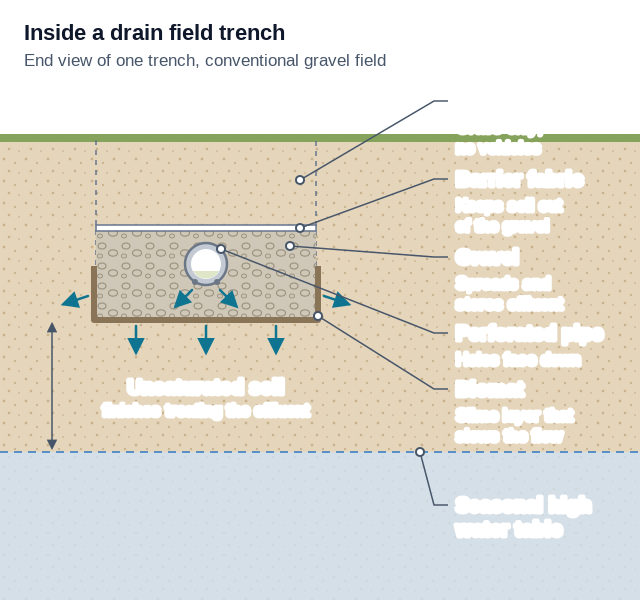
- Choosing the system: under 285.31(b), a standard subsurface absorption system may be used if all soil and site criteria in 285.91(5) are suitable; if any category is unsuitable it cannot be used except as that table notes, and a proprietary or nonstandard system may be used instead if all of its own criteria in 285.91(13) can be met. An absorptive drainfield also needs two feet of suitable soil between the excavation bottom and a restrictive horizon or groundwater (285.33(b)(1)).
- Building and inspection: under 285.3(d), an authorization to construct lasts one calendar year from issuance, the installer must notify the permitting authority at least five working days (Monday through Friday, excluding holidays) before the system will be ready for inspection, and after a failed construction inspection the OSSF may not be used until it passes.
- Affidavit: for the system types that 285.91(12) names, 285.3(b)(3) requires an affidavit recorded in the county deed records before an authorization to construct is issued, and the owner or agent must also give the permitting authority an affidavit affirming the recording. Under procedures BCPHD's OSSF page dates to September 1, 2024, all affidavits must be filed with the County Clerk's Office prior to submitting the septic application, and the clerk's copy goes in with the initial application; without the recorded affidavit an application is rejected, and the full packet must then be re-submitted.
Local Conditions
- Clay that takes water slowly when moist: NRCS's official series description calls Houston Black very deep, moderately well drained and very slowly permeable, formed in clayey residuum from calcareous mudstone, and says water enters it rapidly when it is dry and cracked and very slowly when it is moist.
- A series named here: NRCS took the Heiden name from the Heidenheimer community in southeastern Bell County and set its type location near Heidenheimer. Its description lists a very slow permeability class and high shrink-swell potential.
- Limestone near the surface: in NRCS's words, Eckrant soils are "very shallow to shallow over indurated limestone bedrock," which its range of characteristics puts 4 to 20 inches down, while Purves soils are shallow, well drained and moderately slowly permeable, formed in interbedded limestone and marl. In the Bell County soil survey (TX027), the Purves component of "Purves silty clay, 1 to 4 percent slopes" (25,936 acres) is rated "Very limited" for septic tank absorption fields because of depth to bedrock, and both components of the "Eckrant-Purves association, 1 to 8 percent slopes" (24,779 acres) draw the same rating, with large stones also listed for Eckrant.
- Flood plains: "Tinn clay, 0 to 1 percent slopes, frequently flooded" (21,879 acres) is rated "Very limited" for flooding and slow water movement, and NRCS says flooding on Tinn soils is common except where the soil is protected. BCPHD's flood plain page says a flood plain does not rule out a septic installation, though particular installation practices must be followed to prevent tank floatation or damage to electrical components. Under 30 TAC 285.31(c)(2), a system in the 100-year floodplain must be located so a flood will not damage it and contaminate the environment, and its planning materials must show how tank flotation is eliminated; inside the regulated floodway, the rule requires further showings by a professional engineer.
- Rainfall: NOAA's 1991-2020 annual precipitation normal for the Killeen station (USC00414792) is 34.75 inches.
Communities Served
Killeen · Temple · Belton · Pendleton · Morgan's Point Resort · Little River-Academy · Troy · Rogers · Holland · Salado · Nolanville · Harker Heights
Emergency Response Expectations
Surface discharge from an OSSF component is one form of nuisance under 30 TAC 285.2. Emergency repairs are limited to the 285.35 conditions in the FAQ below, including written notice to the permitting authority (here, the health district) within 72 hours after starting, with a detailed description of the methods and materials used. Because replacing a drainfield is a repair that needs a permit, contact the district's On-Site Wastewater Division through its office page before a new field goes in.
Bell County FAQs
Do I need a permit just to replace the drain field on my Bell County property?
Yes. 30 TAC 285.2 treats replacing a drainfield as a repair needing a permit for the entire system, and BCPHD's rule 1 makes every OSSF repair subject to a permit and inspection no matter how large the tract. Emergency repairs under 285.35 have their own conditions; ask the district which applies.
After the district finds my system malfunctioning, how long do I have to start the repair?
30 TAC 285.70(a) sets the deadline to initiate repair, counted from the date the owner is notified by the executive director or the authorized agent: the 30th day if the owner has not been notified of the malfunctioning system during the previous 12 months, the 20th day if notified at least once in that period, and the 10th day if notified at least twice. These are deadlines to begin the repair, not to finish it. A malfunctioning OSSF, under 285.2, is one causing a nuisance or not operating in compliance with the chapter.
Can the new field sit beside the slab or under a driveway?
A subsurface field cannot go within 5 feet of the slab: the district's rule 12 says no subsurface disposal system may be installed within 5 feet of a home or building's foundation (slab). Statewide, 285.39(c) bars owners from letting a driveway, storage building or other structure be built on top of the treatment or disposal system, and BCPHD's permitting-process sheet keeps the permitted area free of added construction or surface improvements and requires it to stay vegetated. Other separation distances come from 285.91(10), and 285.30(b)(4) has them shown on the site drawing.
Is a cut drip line or broken solid line an emergency repair?
It can be. Under 30 TAC 285.35, an emergency repair may be made if it is for the abatement of an immediate, serious and dangerous health hazard and does not constitute an alteration of the system's planning materials and function. The rule's examples include repairing damaged drip irrigation tubing and repairing solid lines, along with replacing tank lids and inlet and outlet devices, repairing risers and riser caps, and repairing or replacing disinfection devices, and such repairs must meet the chapter's criteria. The individual authorized to make the repair must notify the permitting authority in writing within 72 hours after starting, with a detailed description of the methods and materials used, and the permitting authority may require an inspection.
My spray heads are near the property line. When may they run?
Under 30 TAC 285.33(d)(2)(G)(i), if the edge of the surface application area is less than 20 feet from the property line, timers must be set to spray between midnight and 5:00 a.m. The district's Septic or Aerobic Treatment guide gives the window as "between midnight and 6 AM" for spray within 20 feet of a property line. Ask the district which window it applies before setting a timer.
Sources
- BCPHD: On-Site Sewage Facilities
- BCPHD: OSSF Process
- BCPHD: Additional Rules beyond Chapter 285
- BCPHD: On-Site Sewage Fees (effective September 1, 2024)
- BCPHD: Application to Construct OSSF
- BCPHD: OSSF Permitting Process
- BCPHD: Septic or Aerobic Treatment guide
- BCPHD: Flood Plain Management
- TCEQ OARS: authorized agent search by county (choose Bell)
- TCEQ report: Types of Systems Installed by Time Period (2025)
- Texas SOS: 30 TAC 285.2: Definitions
- Texas SOS: 30 TAC 285.3: General Requirements
- Texas SOS: 30 TAC 285.30: Site Evaluation
- Texas SOS: 30 TAC 285.31: Selection Criteria
- Texas SOS: 30 TAC 285.33: Effluent Disposal Systems
- Texas SOS: 30 TAC 285.35: Emergency Repairs
- Texas SOS: 30 TAC 285.39: Management Practices
- Texas SOS: 30 TAC 285.70: Malfunctioning OSSFs
- USDA NRCS Web Soil Survey (survey area TX027)
- NRCS official series description: Houston Black
- NRCS official series description: Heiden
- NRCS official series description: Eckrant
- NRCS official series description: Purves
- NRCS official series description: Tinn
- NOAA NCEI 1991-2020 normals, Killeen (USC00414792)
- Census Bureau: 2020 place-by-county relationship file, Texas
Last reviewed 2026-11-10
Nearby Counties
Services Available in Bell County
Drain Field Replacement
A failed drain field usually requires a new field on fresh soil, sized to current code. Connect with local licensed installers for site evaluation and quotes.
Learn more →Drain Field Repair & Rejuvenation
Many slow or soggy drain fields can be repaired for $1,000–$5,000 when the problem is a broken pipe, a failed D-box, or clogged laterals rather than worn-out soil.
Learn more →Perc Test & Site Evaluation
A perc or soil test tells the designer how fast your soil accepts effluent, which sets field size and type. Expect $600–$2,000.
Learn more →Aerobic (ATU) Spray & Drip Field Installation
Where soil is too tight, shallow or wet for a conventional field, the answer is usually an ATU that discharges to a spray field or drip lines. $10,000–$20,000+.
Learn more →Free Tools Before You Call
Ballpark the cost or narrow down the problem before talking to a Bell County provider.
Need help in Bell County, TX?
Send the short form — urgent requests get priority routing.