Drain Field Repair in Union County, NC
Drain field replacement typically runs $3,000–$15,000 nationally, per our cost guide. Independent local pros serving Monroe, Waxhaw, Indian Trail and nearby communities. Describe the problem and we'll route your request — free, no obligation.
- Replacement typically $3,000–$15,000 (avg $7,900, HomeGuide)
- Mound, drip and aerobic systems $10,000–$20,000+
- Free quotes from licensed local installers
Fast response from independent local providers. No obligation.
Typical national cost$3,000 – $15,000Cost guide →Local Help in Union County, NC
Union County's own septic permits, repair permits included, come from the On-site Water Protection Program in the county's Environmental Health division. The program evaluates soils and sites, designs, permits and inspects new systems, handles repairs of existing ones and answers complaints. Its septic page says a soil and site evaluation is required for any new system and for repairs or expansions of existing ones. The county describes a repair as starting with a request from the homeowner, or someone representing them, to repair a malfunctioning system; an Environmental Health Specialist or Licensed Soil Scientist then visits the site, assesses the problem and makes recommendations before the repair permit is issued.
State law sets the permit floor. Under G.S. 130A-336(b), nobody may start or help with the installation, construction or repair of a wastewater system without an Improvement Permit and a Construction Authorization from the state or the local health department, unless the work follows an engineered option permit (G.S. 130A-336.1) or the Authorized On-Site Wastewater Evaluator option (G.S. 130A-336.2). The same subsection says maintenance needs neither permit. The health department issues the Construction Authorization for an installation or repair once a field investigation shows the system can be installed and operated in compliance with the law and rules.
Union County Water says not all areas of the county are in its water and wastewater service area, that Marshville, Monroe and Wingate serve some properties, and that some areas have no public water system and depend on wells and septic systems.
Union County Service Details
What providers in this area actually see: coverage, common jobs, local pricing factors, and rules worth knowing.
Service Area Notes
- Mark the utilities first. Union County's Utilities Locating Agreement says soil and site evaluations, including those for repairs and expansions, and existing-system inspections will not be done until the owner or authorized agent has located the underground lines that could interfere with probing or augering, such as water and irrigation lines, electric, telephone, cable and gas lines. If lines are not clearly marked, delays may follow and a revisit fee may be charged. The form names North Carolina 811 as a no-charge service that locates power lines (except private lines), cable and telephone lines.
- Backhoe: a note on the county's fee page says the owner or applicant must provide a backhoe with a bucket at least 2 feet wide and a trained operator for new-system soil and site evaluations, and that no backhoe is required when an evaluation looks at an existing system for repair or expansion. The septic page's general instructions tell applicants to arrange one for the scheduled evaluation, so confirm what a repair visit needs.
- Old permit files can be requested through the county's Existing Septic and Well Permit Records Request form, one way to see what was approved for the lot before work starts.
Common Jobs in Union County
- Drain field repairs under a county repair permit (listed on the fee page as a Construction Authorization) issued after the site visit
- Component replacements, which the county's fee page lists as a separate permit
- Repairs to low-pressure pipe (LPP), pretreatment and pump systems, which the county names as examples of systems its state-mandated operation and maintenance program requires to be inspected
- Pump-and-haul service while a repair is built, when the notice of violation requires it under 15A NCAC 18E .1306(c)(3)
- Closing a field found nonrepairable, which Rule .1306(f) bars from further use and sends to abandonment under Rule .1307
What Drives Pricing Here
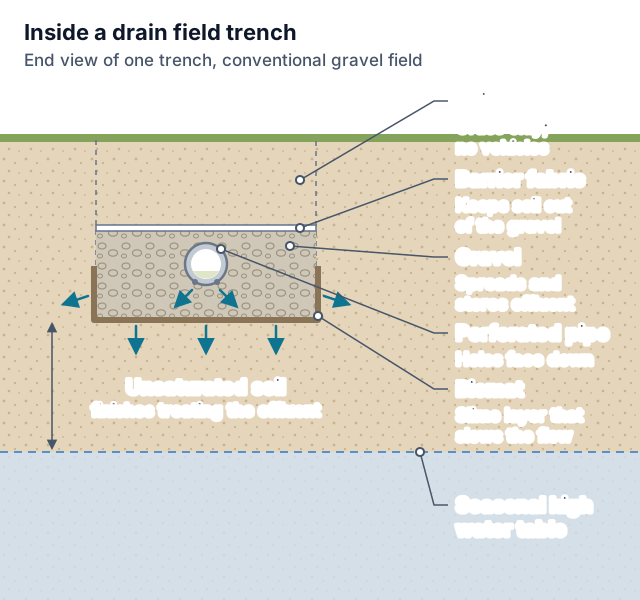
- Depth to rock: Rule 18E .0901(a) requires at least 12 inches of naturally occurring soil between the trench's infiltrative surface and any limiting condition. Badin soils, for one, have weathered bedrock 20 to 40 inches down (see the soil notes below).
- Fill: if any part of the trench or bed media sits above the natural soil surface, Rule .0901(b) makes it a fill system that must meet Rule .0909.
- System type: the county's fee page prices construction authorizations separately by system type, from Type IIc to Type VI. Its amounts are not quoted here because the page prints no effective date; ask Environmental Health for the current figure.
Permits & Local Rules
- Repair timing: under Rule 18E .1306, the local health department or the state Department issues a written notice of violation, and the system must be repaired within 30 days of the date on that notice unless the notice sets a different time frame for site-specific factors such as the severity of the repair, wastewater backing up into a restaurant or discharging into SA waters, or adverse weather that delays construction. The owner applies for the repair under Section .0200 unless maintenance alone will bring the system into compliance, and the repair must eliminate any public health hazard.
- Covering and use: G.S. 130A-337(a) bars covering a new or repaired system or putting it into use until a local health department inspection finds it was installed or repaired as the permits, rules and statute require. Subsections (a1) and (a2) set alternative inspection routes, through an Authorized On-Site Wastewater Evaluator or licensed engineer, or a certified Private Compliance Inspector, each with its own conditions and filing duties; read them before relying on either. Under subsection (d), no system may be put into use or reuse until an operation permit is issued (or a manufactured home park authorization under subsection (c)).
- Who does the work: G.S. 90A-72(a) requires certification by the North Carolina On-Site Wastewater Contractors and Inspectors Certification Board, at the level required for the system, to construct, install or repair a permitted system. Subsection (b) lists exemptions. One covers a person who constructs, installs or repairs a system described as a single septic tank with a gravity-fed gravel trench on land that person owns, for use only by that person and immediate family members living in the same dwelling; another covers a person employed by a certified contractor or inspector whose work is done under the direct and personal supervision of the certified contractor or inspector in charge. These are exemptions from certification; the permit requirement is in G.S. 130A-336.
Local Conditions
- Soil survey: the NRCS soil survey database for Union County (survey area NC179) lists map units named for Badin, Tarrus, Cid, Goldston and Appling soils, a Secrest-Cid complex and frequently flooded Chewacla silt loam.
- Badin: NRCS describes the series as moderately deep and well drained, formed in residuum from fine-grained metasedimentary and metavolcanic rocks of the Carolina Slate Belt, with weathered bedrock at 20 to 40 inches and hard bedrock at 40 inches or more.
- Cid: moderately deep, moderately well drained or somewhat poorly drained, with slow permeability and a perched water table 1.0 to 2.5 feet below the surface in winter and spring.
- Secrest: a series established in Union County in 1991; it is somewhat poorly to moderately well drained, with a perched seasonal high water table less than 20 inches deep from November to March and soft bedrock at 40 to 60 inches.
- Rain and flooding: NOAA's 1991-2020 annual precipitation normal for the Monroe 2 SE station (USC00315771) is 47.79 inches. The county's heavy-rain handout says a system may not work until floodwaters recede and the water table drops below the tank and drainfield trenches, and that vehicles can crush drainfields, tanks and distribution boxes, especially when the soil is saturated.
Communities Served
Monroe · Waxhaw · Indian Trail · Stallings · Marshville · Wingate · Weddington · Mineral Springs · Marvin · Unionville · Wesley Chapel · Hemby Bridge
Emergency Response Expectations
If sewage backs up into the house or surfaces near the system, the county's heavy-rain handout says to stop using water. Rule 18E .1303(a)(2) treats either condition as a malfunction and requires the owner to contact the local health department, and also the engineer or AOWE if the system was permitted through one. We pass requests to independent local septic contractors; how soon one responds depends on the company that takes the job.
Union County FAQs
Is a permit required to replace a drain field in Union County?
A repair needs permits; maintenance does not. G.S. 130A-336(b) requires an Improvement Permit and a Construction Authorization before anyone starts a repair, unless the work is done under the engineered option or AOWE routes, and exempts maintenance. Rule 18E .1306(c)(1) likewise calls for a repair application unless maintenance alone restores compliance. Union County issues its repair permit after an Environmental Health site visit.
Can the replacement field go under a driveway or parking pad?
Only with approval under the rules it cites. Rule 18E .0601(f) keeps initial and repair dispersal fields out from under impervious surfaces and areas subject to vehicle traffic unless approved under G.S. 130A-343 and Section .1700. Rule .1303(a)(7) also bars soil disturbance or compaction over the initial and repair field areas, and Rule .0301(a)(8) makes the owner prevent encroachment on the initial system and repair area by utilities, structures and vehicle traffic areas.
What if my lot has no room for a separate repair area?
For systems under Sections .0900, .1500 or .1700, Rule 18E .0508(a)-(b) requires space for both the initial system and a repair area, meeting setbacks and leaving access for operation and maintenance; a site without that space is unsuitable. The rule has two exceptions. Paragraph (c) waives the repair area for a lot that was described in a recorded deed or plat on or before January 1, 1983, is too small for one as the authorized agent determines, has a design daily flow of no more than 480 gallons for a single-family dwelling unit or a single facility, and will generate domestic-strength effluent; under (d) the agent still determines the maximum feasible repair area and lists it on the Improvement Permit, Construction Authorization and operation permit. Paragraph (e) requires a repair area anyway when a flow or strength increase is proposed for a facility permitted under that waiver, or when any new initial system is proposed on a lot where the waiver was used before. Paragraph (f) keeps the waiver for a flow increase when the owner applies to the health department and design daily flow stays at or below 480 gallons per day of domestic-strength effluent, there is enough space to modify the existing system under the rules, the existing site complies and the system is not malfunctioning under Rule .1303(a)(2), and the (d) conditions are met. Paragraph (i) lets a system certified to NSF/ANSI Standard 350, or with data from a two-year field demonstration (the Department specifies what it needs) showing it meets that standard or better, go without a repair area in Group I soils; such a system may treat only domestic-strength effluent, must meet a 20 mg/L total nitrogen effluent standard, is classified Type VI(b), and needs nitrogen evidence from NSF/ANSI testing or TS-II approval included in the Improvement Permit, Construction Authorization or Notice of Intent. Ask Environmental Health whether either exception fits your lot.
What does Union County charge for a septic repair permit?
The county's fee page has separate lines for a repair permit, a component replacement permit and a permit redesign, but it prints no effective date, so this page does not quote the amounts. Check the current fee page or ask the On-site Water Protection Program before you apply.
Sources
- Union County Environmental Health: On-site wastewater (septic) systems
- Union County Environmental Health fees (no effective date printed)
- Union County: Utilities Locating Agreement for septic systems and wells
- Union County: Excessive rains may cause problems with home septic systems
- Union County Water: Service area
- G.S. 130A-336: Improvement permit and construction authorization
- G.S. 130A-337: Inspection; operation permit
- G.S. 90A-72: Certification required; applicability
- 15A NCAC 18E (OAH): Rules .0301, .0508, .0601, .0901, .1303, .1306 and .1307
- NC On-Site Wastewater Contractors and Inspectors Certification Board
- USDA NRCS: Badin soil series
- USDA NRCS: Cid soil series
- USDA NRCS: Secrest soil series
- USDA NRCS Soil Data Access: map units for survey area NC179 (query saved)
- NOAA NCEI: 1991-2020 annual precipitation normal, Monroe 2 SE (USC00315771)
- U.S. Census Bureau: 2020 North Carolina places by county
Last reviewed 2026-11-04
Nearby Counties
Services Available in Union County
Drain Field Replacement
A failed drain field usually requires a new field on fresh soil, sized to current code. Connect with local licensed installers for site evaluation and quotes.
Learn more →Drain Field Repair & Rejuvenation
Many slow or soggy drain fields can be repaired for $1,000–$5,000 when the problem is a broken pipe, a failed D-box, or clogged laterals rather than worn-out soil.
Learn more →Perc Test & Site Evaluation
A perc or soil test tells the designer how fast your soil accepts effluent, which sets field size and type. Expect $600–$2,000.
Learn more →Aerobic (ATU) Spray & Drip Field Installation
Where soil is too tight, shallow or wet for a conventional field, the answer is usually an ATU that discharges to a spray field or drip lines. $10,000–$20,000+.
Learn more →Free Tools Before You Call
Ballpark the cost or narrow down the problem before talking to a Union County provider.
Need help in Union County, NC?
Send the short form — urgent requests get priority routing.